
The deal is close. Then someone asks for the code.
The term sheet looks good. The buyer likes the product, the numbers work, and everyone is talking about a closing date.
Then a line appears in the diligence request list: "Provide access to source code for third-party technical review."
For a lot of founders, that is the first time anyone outside the team will read the code properly. And the code was written fast, by different people, under deadline pressure, over several years. You probably have a rough idea of what is in there. You probably do not have a complete one.
That gap is where deals get repriced, delayed, or wrapped in extra legal protections you did not plan for.
What code audits found in 2025 deals
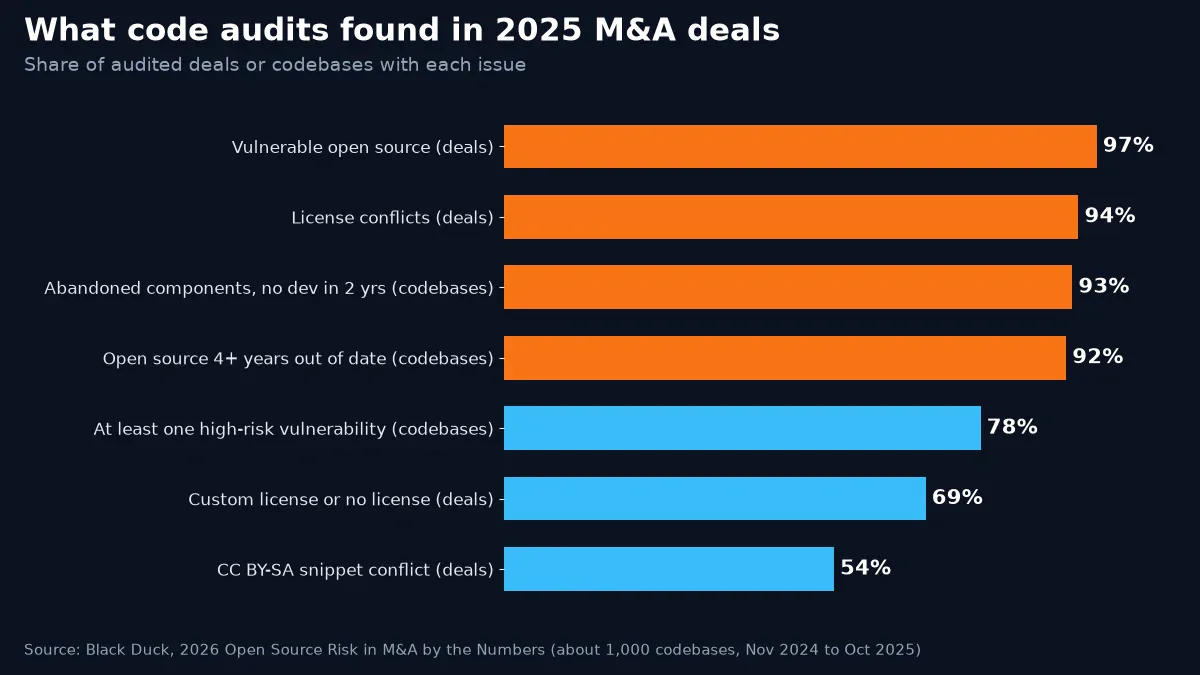
Black Duck runs code audits for buyers in M&A transactions, and every year it publishes what it finds. Its 2026 Open Source Risk in M&A by the Numbers report covers about 1,000 codebases audited across hundreds of deals between November 2024 and October 2025. The results are not reassuring:
- 97% of transactions included unpatched, vulnerable open source, with a mean of 786 vulnerabilities per transaction.
- 78% of codebases had at least one high-risk vulnerability, meaning it has been actively exploited, has a documented proof-of-concept exploit, or allows remote code execution.
- 94% of transactions had open source license conflicts.
- 69% of transactions included open source with a custom license or no license at all.
- 92% of codebases had open source more than four years out of date, and 93% included components with no development activity in the last two years.
- Only 84% of open source components could be found by scanning package files. The rest came in other ways: vendor code copied into the repo, snippets from Stack Overflow or AI assistants, and binaries with no source.
These are not careless companies. They are companies good enough to get acquired. The lesson is simple: almost every real codebase has these issues. What separates a smooth diligence from a painful one is whether you found them before the buyer did.
The surprise most founders miss: copied snippets
One finding deserves its own section because it catches so many teams off guard.
The most common license conflict in the audited deals involved Creative Commons Attribution ShareAlike, found in 54% of transactions. Why would a software company have a Creative Commons license in its code? Because public contributions on Stack Overflow are licensed under it, and developers copy snippets from Stack Overflow every day.
ShareAlike works a bit like the GPL. Work derived from it is supposed to carry the same terms. Creative Commons itself recommends against using its licenses for software. So a ten-line helper function pasted in 2021 can turn into a question from the buyer's lawyers in 2026.
AI coding assistants add a newer version of the same problem. They can suggest code that closely matches open source without carrying its license, and the report notes that developers accept an average of 30% of AI-suggested snippets. If your team writes code with AI help, and most teams now do, assume some of that code needs the same scrutiny as a copied snippet.
If you have not already sorted out who owns the code your contractors and agencies wrote, start there. Our IP checklist for founders covers the contract side. This post is about what is inside the code itself.
What reviewers actually look at
Every buyer and investor is different, but technical due diligence in the US, UK, and UAE tends to cover the same ground:
- Open source and licenses. What components you use, under which licenses, and whether any conflict with how you sell or distribute your product.
- Security. Known vulnerabilities, outdated dependencies, secrets in the code, how authentication and access control work, and whether you have had incidents.
- Architecture and scalability. Whether the system can handle the growth in the plan, or needs a rebuild the buyer would have to fund.
- Code quality and technical debt. Tests, documentation, how hard the code is to change, and how much of it only one person understands.
- Infrastructure and operations. Hosting, backups, monitoring, deployment, and who has access to production.
- Team and process. How code is reviewed, how releases happen, and what breaks if a key engineer leaves.
As a bug hunter, I have found serious issues in code that looked perfectly clean from the outside. A diligence reviewer works the same way. They are not judging how the product looks. They are looking for the one old library or forgotten key that changes the price.
A founder's pre-diligence checklist
You do not need to be perfect. You need to know your risks, fix the serious ones, and be able to explain the rest. Here is the order I would work in, ideally three to six months before a raise or sale.
1. Build a software bill of materials
A software bill of materials (SBOM) is a list of every third-party component in your product, with versions and licenses. Most targets cannot produce one easily, according to Black Duck, and when they can it is rarely complete. Being the company that hands one over on day one sends a strong signal about how you run engineering.
Free scanners for your package files will get you most of the way. Then look for the rest by hand: vendored folders, copied libraries, and binaries checked into the repo.
2. Patch or remove high-risk vulnerabilities
Run a dependency scan and sort by severity. Fix anything that is actively exploited or allows remote code execution first. In the audit data, jQuery was the second most common component with vulnerabilities and appeared in 64% of deals, even though fixes for all of those jQuery issues already exist. Old frontend libraries are an easy place to start.
3. Replace abandoned and badly outdated components
A dependency with no updates in two years is a risk even if it has no known vulnerabilities today, because nobody will fix the next one. The longer you wait, the harder the upgrade, since every skipped version makes the jump bigger.
4. Clean up licenses and snippets
Check for copyleft licenses like GPL or AGPL in anything you distribute, components with no license, and copied snippets. For each one, decide whether to replace it, rewrite it, comply with the license, or document why it is fine. Write those decisions down. Reviewers care about a clear answer more than a perfect score.
5. Remove secrets and tighten access
Search the full git history for API keys, passwords, and tokens, not just the current code. Rotate anything you find. Then list who has access to production, the code, and the cloud accounts, and remove people who no longer need it, especially former contractors.
6. Document the system
A short architecture overview, a diagram, setup instructions, and a list of known issues go a long way. Documentation also answers the question every buyer quietly asks: what happens if the original developer leaves?
7. Write the honest risk list yourself
Make a one-page list of the known weak spots and your plan for each. Reviewers will find most of them anyway. When you raise them first, with a plan, it reads as maturity. When they find them, it reads as risk.
What it costs to leave this until the deal
When problems show up during diligence, you have the least time and the least leverage to fix them. The common outcomes are a lower price, part of the price held back until fixes are done, extra warranties and indemnities in the contract, or a delayed close while engineers scramble. Sometimes the buyer walks.
None of that is because the code had issues. Almost every codebase does. It is because the issues were found late, by the other side.
How we help founders get diligence-ready
At Fionetix, we have spent more than ten years building and securing software where mistakes are expensive, including banking platforms and systems for the Bangladesh Navy and Army. That background, plus a Meta (Facebook) Hall of Fame recognition for security research, shapes how we review code: like an outside reviewer would, before the outside reviewer arrives.
For founders in the US, UK, and UAE, our Legacy Fix & Server package covers most of the checklist above:
- Diagnose and fix legacy issues, including outdated and vulnerable components
- Performance and security hardening
- Server setup and access cleanup
- A stabilized, documented handover your buyer or investor can actually read
It is a fixed $1,999 package, and you keep 100% of the code and IP from day one. If you just want an experienced second opinion on what a reviewer would find, hourly consultancy starts at $30.
Find it before they do
Technical due diligence is not a test you pass by having perfect code. It is a test of whether you know what is in your product and have a plan for the risky parts.
Build the inventory, fix the serious issues, write down the rest, and walk into diligence with answers instead of surprises.