
A buyer asked for a badge. Ask which one before you buy it
A founder forwards a security questionnaire, or a sentence in a contract that says the supplier will "maintain SOC 2 or ISO 27001." The deal is real. The runway is not. The instinct is to book an auditor this week.
That instinct gets expensive in two ways. You buy the document the buyer will not accept, or you buy the right document before the controls have any history an auditor can test.
I have spent more than ten years building and securing software, including systems for banks and defense teams. The audits in that work all photograph the same thing: what the team already does on a normal Tuesday. A policy written the night before the kickoff call does not survive that photograph.
This post is the decision I walk founders through before anyone signs an audit engagement. It is about SOC 2, ISO/IEC 27001, and the cases where neither belongs on this quarter's card. Everyday hygiene (passwords, patches, backups) still matters. It is a different job from choosing an audit.
SOC 2 is a report. ISO 27001 is a certificate
People use "certified" for both. The two artifacts are different, and procurement teams know it.
What a SOC 2 report covers
SOC 2 is an examination by a CPA firm. The AICPA describes it as a report on controls at a service organization relevant to security, availability, processing integrity, confidentiality, or privacy. The criteria are the 2017 Trust Services Criteria, with revised points of focus from 2022.
The AICPA's SOC 2 guide splits the work into two reports:
- A Type 1 report looks at whether the description of the system is fair, and whether the controls were suitably designed, at a point in time.
- A Type 2 report covers that design and also whether the controls operated effectively throughout a period. It includes the auditor's tests and the results of those tests.
Every SOC 2 report addresses the Security category. In the criteria, those are the common criteria (control environment, communication, risk assessment, monitoring, and control activities such as access, operations, and change management). Availability, processing integrity, confidentiality, and privacy are extra categories. Vanta's cost guide says most companies should include only Security unless a contract asks for more, and that Privacy is the expensive add-on.
The detailed report is written for specified parties who understand the system. There is a shorter SOC 3 report on the same categories, with less detail, and the AICPA treats that one as suitable for general distribution. Plan to share the SOC 2 PDF under NDA. Plan to put a SOC 3, if you commission one, on the website.
What an ISO/IEC 27001 certificate covers
ISO/IEC 27001:2022 is the current international standard for an information security management system (ISMS). ISO published this third edition in October 2022. A 2024 amendment exists. The 2013 edition has been withdrawn. If a contract says "ISO 27001," ask whether they mean certification to ISO/IEC 27001:2022.
ISO's own page is clear on two points founders mix up. The standard defines requirements for the management system. Certification is optional. Some companies implement the standard for themselves. Others also get certified because customers ask. ISO develops the standard. An accredited certification body issues the certificate. ISO's wording is to say "certified to ISO/IEC 27001:2022," and to get the logo rules from the body that certified you.
ANAB, the US accreditation body for many of those certification bodies, notes that the 2022 edition has 93 Annex A controls, grouped into four themes: organizational, people, physical, and technical. That replaced 114 controls in the 2013 edition. You still decide which controls apply to your risks and your scope, and you record that decision. An auditor expects to see the decision, the risk assessment behind it, and evidence that the chosen controls operate.
Vanta's ISO 27001 cost guide describes the commercial cycle this way: a Stage 1 documentation review, a Stage 2 certification audit, surveillance audits, and a certificate that is valid for up to three years if surveillance stays clean. Recertification comes at the end of that term. Fail a surveillance audit and you are back in a full recertification.
The difference that changes the sales call
SOC 2 hands the buyer's security reviewer a long report about a defined system, over a defined period, against the Trust Services Criteria. ISO 27001 hands them a certificate that an accredited body says your ISMS meets ISO/IEC 27001:2022, plus a scope statement they can read in a minute.
Neither document means "we will never be breached." Both mean an independent party looked at how you manage security, inside the scope you agreed. A buyer who wanted a pen test, a business-associate agreement, or a data-processing addendum will still ask for those.
Who asks for which
There is no statute that says a Delaware C-corp must hold SOC 2 and a Dubai startup must hold ISO 27001. There is a procurement habit, and it is strong enough to plan around.
Cognisys, a UK security firm, describes it this way: US SaaS buyers often gate a deal on a SOC 2 report, because it matches the vendor-risk files their own auditors expect. Buyers outside North America, including the UK, Europe, the Middle East, and APAC, more often ask for an ISO 27001 certificate, because someone in procurement can check a certificate without interpreting a restricted report.
Treat that as field experience from people who sit in these reviews, not as a census. The email from your prospect outranks any blog, including this one. Reply with three questions:
- Which document does this contract require: a SOC 2 report, an ISO/IEC 27001:2022 certificate, or either?
- If it is SOC 2, will a Type 1 unblock this signature, or do you need a Type 2? Vanta notes that a growing number of buyers ask for Type 2 and will not accept Type 1 on its own.
- What date do you need it, and is a dated letter (controls in place, audit booked) enough to keep the deal moving?
Write the answers down. They are the scope.
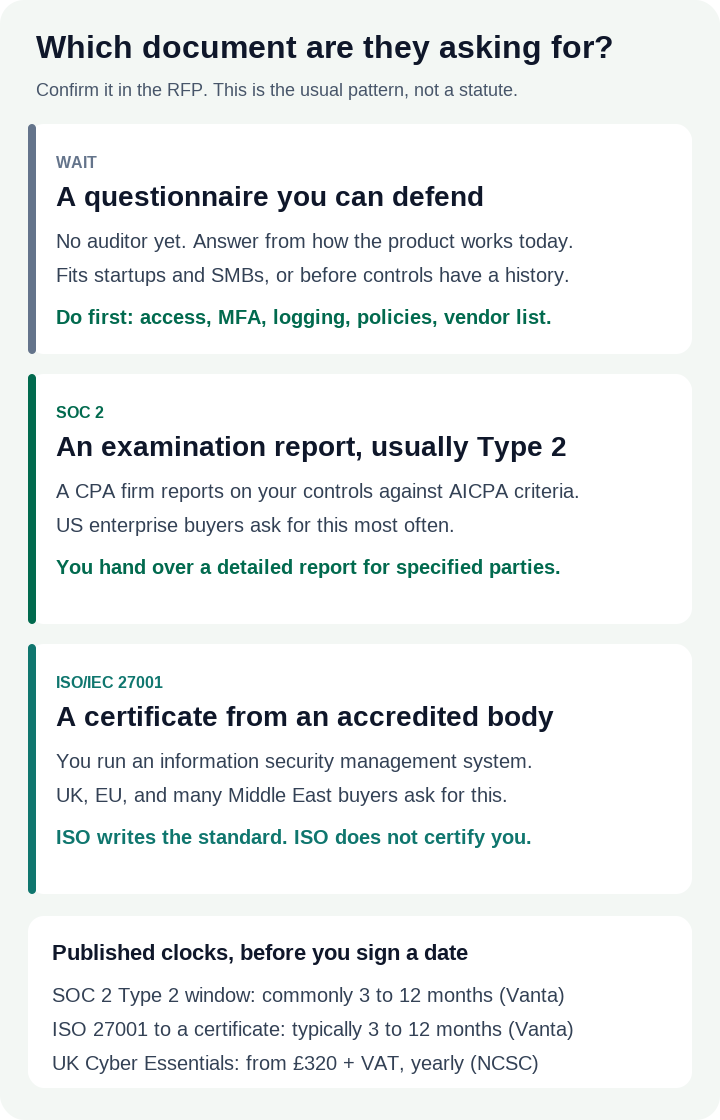
If you sell from Dhaka, Austin, London, or Dubai into a customer in one of the other cities, the questionnaire follows the buyer. A Bangladesh private limited company selling to a US enterprise is in a SOC 2 conversation. The same product selling into a UK or UAE enterprise procurement team is more often in an ISO 27001 conversation. Build the controls once. Commission the report the revenue needs.
The cheaper UK gate, and the UAE rules that are not badges
Two local regimes get waved around in the same breath as SOC 2. They are real. They are not substitutes.
United Kingdom: Cyber Essentials
Cyber Essentials is the UK government-backed baseline, developed by the National Cyber Security Centre and delivered by IASME. It tests five technical controls: firewalls, secure configuration, security update management, user access control, and malware protection. There are two levels. Cyber Essentials is a verified self-assessment. Cyber Essentials Plus adds independent technical testing. The NCSC prices the first level from £320 + VAT. Plus is quoted against the size and complexity of the network.
IASME's fee table scales the self-assessment by headcount, all plus VAT: £320 for 0 to 9 people, £440 for 10 to 49, £500 for 50 to 249, and £600 for 250 or more. The certificate is renewed yearly when a contract requires it. The NCSC also says a UK organisation with turnover under £20 million, certified for the whole organisation, is entitled to cyber liability insurance arranged by IASME. Read the current terms before you count on the policy.
For central government, executive agencies, non-departmental public bodies, and NHS bodies, Procurement Policy Note 014 (February 2025) tells buyers when to ask. Higher-risk contracts include ones that handle citizen or government-staff personal data, ICT at OFFICIAL, or information about the day-to-day business of government. For those, the note points to Cyber Essentials or Plus, or to equivalent controls demonstrated another way. It also says not to apply the scheme to every contract, and that the scheme does not assure a specific product. Where the risk is higher than those five controls, the buyer can ask for more. G-Cloud suppliers are encouraged to list Cyber Essentials. The framework itself does not require the certificate.
So a UK public-sector deal can be a few hundred pounds and five controls, renewed annually. It can also be ISO 27001 if the tender names ISO 27001. Read the tender. IASME is running a 75% fee discount for eligible UK micros and SMEs who have not held Cyber Essentials in the last four years, if they register and pay by 31 March 2027. Eligibility is checked at registration, and the discount does not cover Plus or the work of getting ready.
UAE: a privacy law, and a national standard for critical systems
Federal Decree-Law No. 45 of 2021 is the UAE Personal Data Protection Law. The UAE government says it came into force on 2 January 2022. It sets rules for processing personal data and for securing that data. It does not hand you a SOC 2 report or an ISO certificate. Holding either report does not, by itself, mean you comply with the law.
The UAE Information Assurance Standard, published by the UAE Cyber Security Council, is the national control set people still call NESA. The Council describes it as a framework for critical information infrastructure, for government and non-government entities responsible for critical information systems. The Council says the standard aligns with ISO/IEC 27001, NIST SP 800-53, and the CIS Controls.
If the customer is a ministry, a federal authority, or an operator of critical information infrastructure, ask whether they expect the UAE IA Standard, an ISO 27001 certificate, or both. A private-company SaaS purchase in Dubai is a different question. Do not buy a badge the customer did not name, and do not assume the national standard applies to every UAE buyer.
When you need one, and when you should wait
Start SOC 2 when a US enterprise deal is blocked on it, the buyer has said Type 1 or Type 2 in writing, and the close date leaves room for the window. Vanta's timeline guide puts Type 1 preparation at one to three months, the audit at two to five weeks, and the report at another two to six weeks. A Type 2 adds an observation window.
Start ISO 27001 when a UK, EU, or GCC enterprise contract or tender names the certificate, and you can live with a multi-month build of the management system. Vanta's timeline says certification typically takes 3 to 12 months: on the order of 1 to 4 months of preparation, then the certification body's Stage 1 and Stage 2.
Buy neither yet when all of these are true:
- No current customer or signed pipeline has named a report or a certificate.
- The next year of revenue is other startups and small businesses that accept a straight questionnaire.
- You cannot yet show access reviews, MFA, logging, and vendor records operating over time.
- For a UK government or NHS buyer, PPN 014's Cyber Essentials path is the requirement they actually wrote down.
Verizon's 2025 Data Breach Investigations Report is the reason procurement teams are strict. Across 12,195 confirmed breaches, third-party involvement doubled, to 30%. IBM's 2025 Cost of a Data Breach report put the global average at $4.44 million and the US average at $10.22 million, from 600 organizations that had already suffered a breach. Those figures explain a Fortune 500 security review. They are not the invoice a 12-person startup should expect, and they are not a reason to buy an audit before a single customer has asked.
Buy the audit when a real customer has named the document and the controls have already been running. Anything earlier is a brochure with an invoice.
What the clock and the invoice look like
Nobody publishes a single price. The AICPA does not sell the audit. ISO does not sell the certificate. The ranges below are what Vanta publishes for SOC 2 and ISO 27001, and what the NCSC and IASME publish for Cyber Essentials. Vanta sells compliance software, so read the ranges as a planning band and then get two or three quotes. Do not add the rows together. The "all-in" and "overall" rows already try to cover more than the auditor's fee.
| What you are paying for | Published range | Source |
|---|---|---|
| SOC 2 audit fee (the report itself) | $10,000 to $50,000 | Vanta |
| First SOC 2, all-in, including readiness | $10,000 to $80,000 or more | Vanta |
| SOC 2 with a Big Four firm | Low six figures and up | Vanta |
| ISO 27001 overall, by size and complexity | $6,000 to more than $40,000 | Vanta |
| ISO 27001 Stage 1 and Stage 2, typical combined fee | $14,000 to $16,000 | Vanta |
| ISO 27001 surveillance audit | About $6,000 to $7,500 | Vanta |
| ISO 27001 recertification | $14,000 to $16,000 | Vanta |
| Cyber Essentials, 0 to 9 people | £320 + VAT | NCSC and IASME |
| Cyber Essentials, 10 to 49 people | £440 + VAT | IASME |
| Cyber Essentials, 50 to 249 people | £500 + VAT | IASME |
| Cyber Essentials, 250 or more people | £600 + VAT | IASME |
A few timing facts change the contract you can sign:
- Vanta describes the SOC 2 Type 2 observation window as commonly 3 to 12 months. Early teams often pick a shorter first window (3, 6, or 9 months) and then move to 12. You choose it with the auditor. The auditor then still needs weeks to issue the report.
- Vanta says SOC 2 is repeated, because each report covers a window and customers want a current one. Budget it as a yearly line after year one.
- Vanta's ISO guide puts a rough consultant-led implementation around $30,000, an internal audit anywhere from $0 to $6,000 if your own staff can do it, and penetration testing (a common extra, separate from the certification fee) at $5,000 to $20,000. A readiness assessment on the SOC 2 side starts around $10,000 if you hire one.
- ISO surveillance is the maintenance fee. Vanta prices it at about $6,000 to $7,500, with recertification later at about the same fee as the original Stage 1 and Stage 2 package.
If a salesperson quotes "SOC 2 in two weeks" or "ISO next month" and your MFA, logging, and joiner-leaver process are still a slide, the quote is for a document, not for an operating program.
Do this before you pay an auditor
This is the work that makes a questionnaire honest and makes a later audit shorter. It does not replace a CPA examination or an accredited certification audit.
1. Get the buyer's artifact in writing
Save the email that names SOC 2 Type 2, ISO/IEC 27001:2022, Cyber Essentials, or "equivalent." If they said "or equivalent," ask what they have accepted from a vendor your size in the last year.
2. Build a questionnaire pack you can reuse
The first gate is usually a spreadsheet: access, encryption, subprocessors, incident history, backups, where production runs. Answer from the product as it is, including the gaps. Keep one living copy the founder and the engineer both trust. A finished SOC 2 report shortens the next spreadsheet. It rarely deletes it.
3. Write policies that match Tuesday
Four short policies carry most early questionnaires: access control, acceptable use, incident response, and vendors. One or two pages each, naming the real tools (the identity provider, the cloud account, the person who gets paged). An auditor compares the policy to the practice. A 40-page template nobody has read is a finding waiting to happen.
4. Make access boring
Name who can reach production, the source repo, billing, and the customer database. Separate admin rights from the everyday login. Remove access the day someone leaves, including contractors. Write down the last time you reviewed that list. That single record shows up in both SOC 2 and ISO 27001 evidence requests.
5. Turn on MFA where a stolen password would hurt
Email, the cloud console, source control, and production access. Prefer an authenticator app or a hardware key over SMS. If a founder account is the only admin, add a second person before you talk about an observation window. A Type 2 report tests whether this stayed on during the period, not whether you enabled it the week the auditor arrived.
6. Keep logs you can actually export
Turn on admin and sign-in logs for the identity provider, the cloud account, and the git host. Retain them long enough to answer "show me admin activity for the last quarter," and try the export once. A log setting you have never downloaded is a guess.
7. Write the vendor list
One table: vendor, what customer data they can touch, where it is hosted, who the owner is inside your company, and whether they will share their own SOC 2 report or ISO certificate. Your cloud, email, error tracking, payment, and support tools belong on it. When the buyer asks about subprocessors, this table is the answer. When your auditor asks how you rely on those vendors, it is the answer again.
8. Write the scope in one sentence
"The production service customers log into, in this cloud account, operated by these people." Leave the marketing site, the hackday prototype, and the personal side project out unless they touch customer data. Vanta's SOC 2 guide is blunt about scope: every extra system adds testing, and every extra Trust Services Category adds fee. ISO scope works the same way. A wide scope feels ambitious and prices like it.
How founders waste the audit budget
A few patterns show up over and over.
No named buyer. If nobody has asked, spend the month on the list above. The audit fee does not make the controls exist.
Type 1 as a decoy. Vanta's warning is the right one. If the buyer has already said Type 2 only, a Type 1 is a second project you will pay for again. A Type 1 is reasonable when that same buyer has agreed, in writing, to accept it now and a Type 2 on a date you can hit.
Every category, because the sales deck looks fuller. Security is the category every SOC 2 report includes. Add Availability or Confidentiality when a contract names them. Leave Privacy off until a customer or a regulator forces the question. It is the costly extra.
A full ISO consultant before the tender exists. Vanta's rough figure for a consultant-led ISO implementation is about $30,000, before the certification body's fee. That can be money well spent when a contract requires the certificate this year. It is a bad first purchase when you still have shared admin passwords.
An unaccredited "ISO certificate." ISO tells buyers to look for an accredited conformity assessment body. A PDF from a firm no accreditation body stands behind will fail the first procurement check that looks the name up.
A UK ISO project when the tender says Cyber Essentials. PPN 014 is specific, and the fee is hundreds of pounds, not tens of thousands. If the same tender also names ISO 27001, you still need ISO 27001. If it does not, do not volunteer the larger audit to look serious.
A UAE "NESA certificate" bought from a cold email. Ask the customer whether the UAE IA Standard applies to them, and whether they want that standard, ISO 27001, or both. The Council publishes a control set for entities responsible for critical information systems. It is not a logo every startup in the country is expected to buy.
Scope that includes the whole company "to be safe." Safe, here, means a longer audit. Scope the system that holds customer data. Say so in the report. You can widen it later, on purpose.
Get the habits in place, then buy the document
Pick the artifact from the contract in front of you. For a US enterprise security team, that is usually a SOC 2 report, and often a Type 2. For a UK, EU, or GCC enterprise buyer, that is usually an ISO/IEC 27001:2022 certificate from an accredited body. For a slice of UK central government and NHS work, Cyber Essentials is the requirement actually written into PPN 014. For a startup still selling to other startups, the right purchase is the eight habits above, not an audit.
When you do buy the audit, hire a firm that asks about your systems before it names a price, states the criteria and the scope in the quote, and separates readiness from the audit fee. Then keep the evidence going. The first report is the expensive one. The second year is a test of whether Tuesday still matches the policy.
Fionetix is a software and cybersecurity team. We do not issue SOC 2 reports, and we do not certify companies to ISO 27001. Those come from a CPA firm and an accredited certification body. What we do is the engineering and the readiness around them: access, logging, the vendor list, policies that match the product, and a questionnaire pack your sales lead can send without inventing answers. Our cybersecurity work covers security reviews and compliance readiness. If you want a senior engineer to look at where you are before you sign an auditor, start there.