

Your customer's country picks the rulebook
A founder showed me a privacy policy last month. Two pages, copied from a template, ending with "we respect your privacy." The product already had users in London, Dubai, and California.
That sentence does not decide which law applies. The customer's location does. If you build from Bangladesh, or anywhere else, and sell into the US, the UK, or the UAE, the rules travel with the user.
The same signup form can sit under three laws
United Kingdom. The UK GDPR covers an establishment in the UK, and a controller outside the UK that offers goods or services to people there, paid or not, or monitors their behaviour in the UK.
United Arab Emirates. Decree-Law No. 45 of 2021 has applied since 2 January 2022, including to controllers abroad who process data of people inside the UAE. Free zones with their own personal data law, including DIFC and ADGM, sit outside it.
United States. There is no single federal consumer privacy law for an ordinary app. The IAPP tracker follows comprehensive state laws. On 17 June 2026 IAPP reported Vermont as the 23rd. The tracker page was last updated on 8 September 2026, so check it before you quote a total.
Pricing in pounds, a Dubai phone number, or a California checkout is a much clearer signal than a site someone can merely open. If you are unsure, ask counsel.
United Kingdom: UK GDPR, the fee, and the 2025 Act
The Data (Use and Access) Act 2025 received Royal Assent on 19 June 2025. GOV.UK says it amends the UK GDPR, the Data Protection Act 2018, and the Privacy and Electronic Communications Regulations. It does not replace them. The parts I would put in the backlog:
- Complaints. Section 164A, in force from 19 June 2026, requires an easy route such as an electronic form. Acknowledge within 30 days of receipt, then respond without undue delay. This is separate from an access request.
- Access requests. Article 12A gives one month. You may add two months for complexity or volume if you explain, with reasons, inside the first month. Time spent waiting for information you need to identify the request does not count.
- Analytics cookies. The ICO's statistical purposes exception covers storage used only to improve a service from aggregate usage. Explain it, and offer a simple, free objection. Ads, and anything that identifies the visitor, sit outside it.
- Automated decisions. Solely automated decisions with legal or similar effects can use a wider set of reasons, if people are told, can challenge them, and can get human review. Recognised legitimate interests, such as crime prevention, safeguarding, and emergencies, skip the usual balancing test.
- Children. Services likely to be accessed by children have to be designed with their protection in mind.
If you are a UK controller and no exemption applies, you pay a yearly data protection fee. Regulation 3, amended from 17 February 2025, sets £52 (turnover of £632,000 or less, or 10 staff or fewer, and also charities and small occupational pension schemes), £78 (up to £36 million or 250 staff), and £3,763 above that. Direct debit takes £5 off. The ICO's fixed penalties for not paying are £400, £600, and £4,000 by tier, and that page states a ceiling of £4,350 if you do not give enough information to set the fee. Section 158 caps a fixed penalty at 150% of the highest charge, ignoring the discount.
The larger ceilings are in the ICO's fining guidance: a standard maximum of £8.7 million or, for an undertaking, the higher of that sum or 2% of worldwide annual turnover, and a higher maximum of £17.5 million or 4% on the same basis. The percentage enters that calculation only once turnover exceeds £435 million (standard) or £437.5 million (higher). The principles guide puts basic-principle infringements in the higher tier.
United Arab Emirates: one federal law, two financial centres
The UAE government portal points founders at Decree-Law No. 45 of 2021. The Data Office, under the Cabinet, issues the guidance. From the English text:
- Article 4. No processing without consent, unless an exception applies: public interest, a contract, pre-contract steps the person asked for, legal claims, certain employment or health purposes, or a case the Executive Regulations add. Consent is a specific, clear, positive act.
- Article 5. Fair, transparent, and lawful; a clear purpose; limited to what is necessary; accurate; secure; deleted when the purpose ends, unless the person can no longer be identified.
- Articles 13, 14, and 17. Free information on what you hold, why, automated decisions, sharing, retention, and how to correct, erase, or limit it. A machine-readable copy when processing is by consent or contract and is automated. A right to stop direct marketing, including related profiling.
- Articles 22 and 23. Transfers abroad need a route such as an adequate destination, explicit consent that respects UAE public and security interests, or performance of a contract with the person.
- Article 9. No hour count. Notify the Data Office in the period the Executive Regulations set, with a description, the data protection officer, likely effects, and the fix, and tell the person on that timetable when their privacy would be prejudiced. Processors tell the controller as soon as they know. Article 26 leaves penalties to the Cabinet. The decree states no fine, and it does not say 72 hours.
DIFC. Article 2(2)(g) is why this regime, not the federal decree, applies inside the centre. Law No. 5 of 2020 has applied since 1 July 2020 (consolidated July 2025). Article 41: tell the Commissioner as soon as practicable if confidentiality, security, or privacy is compromised. Article 42: tell the person as soon as practicable when the risk is high, and promptly if damage is immediate. The FAQ confirms there is no 72-hour limit. Schedule 2 caps a missed Article 41 or 42 report at $50,000. Article 62(3) allows a general fine above that cap.
ADGM. The Office of Data Protection requires notice without undue delay and, where feasible, within 72 hours, matching section 32 of the Data Protection Regulations 2021.
Personal health data with its own law sits outside the federal decree. The government portal points to Federal Law No. 2 of 2019 on ICT in health. Clinic records need that law and a UAE health lawyer.
United States: state laws, plus HIPAA and COPPA when they apply
California is the law buyers name first. The CCPA covers a for-profit business doing business there that meets a test in Civil Code section 1798.140. The CPPA set the revenue threshold at $26,625,000 from 1 January 2025. The code's other tests are unchanged: personal information of 100,000 or more consumers or households bought, sold, or shared in a year, or 50 percent or more of revenue from selling or sharing it.
The same CPPA adjustment, from 1 January 2025, sets administrative fines at not more than $2,663 per violation, or $7,988 if intentional or if the consumer is known to be under 16. Statutory damages for certain breaches of nonencrypted, nonredacted personal information are $107 to $799 per consumer per incident, or actual damages if higher. Section 1798.150 requires 30 days' written notice before a suit for those damages, and a cure where one is possible. Better security after the breach is not a cure.
Other comprehensive state laws are mostly attorney-general enforcement. Vermont, the 23rd in IAPP's June 2026 report, was signed on 16 June 2026 and takes effect on 1 January 2028: attorney general only, a 60-day cure period through 30 June 2029, and coverage above 35,000 residents, or sensitive data of at least 3,000, or a sale covering at least 3,000. Thresholds differ. Use the IAPP chart for the state you sell into.
HIPAA applies when you are a covered entity or you handle protected health information for one. 45 CFR 164.404 requires notice to each affected person without unreasonable delay, and no later than 60 calendar days after discovery of a breach of unsecured protected health information. A notes field that mentions a doctor is not the same product as a clinic record system.
COPPA covers sites directed at children under 13, and operators who know they are collecting personal information from children under 13. The FTC's 2025 amendments were published on 22 April 2025, effective 23 June 2025, with a general compliance date of 22 April 2026. They add government-issued identifiers and biometrics to personal information, and they keep parental notice plus verifiable parental consent before collection.
The clocks are the part you feel at 2am
Policies do not send the notice. A person does, inside a window that has already started.
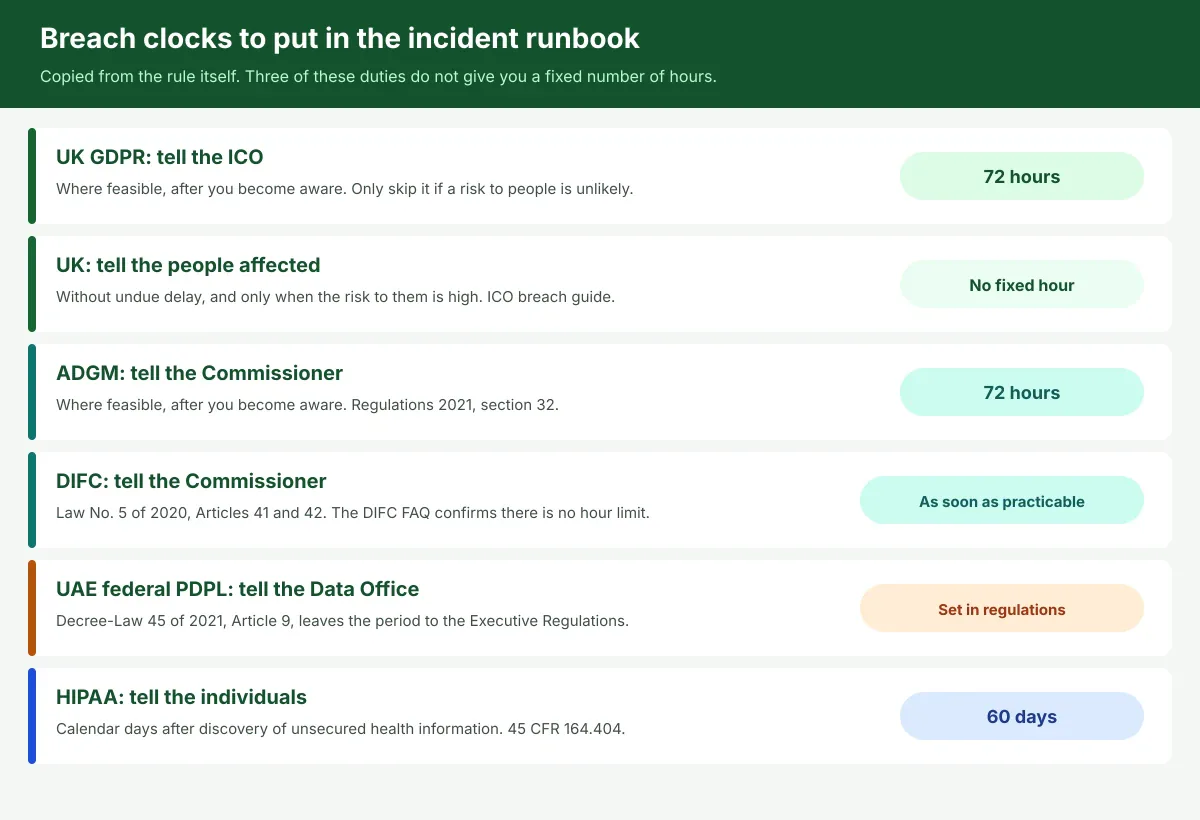
Article 33 is the first row: notify the ICO within 72 hours where feasible, unless a risk to people is unlikely. The ICO's breach guide puts a missed notification at up to £8.7 million or 2 percent of global turnover, and says you still record breaches you do not report. On 20 August 2025 that guide moved PECR security breach reports from 24 hours to 72. Log the moment your team becomes aware, or a Monday filing of a Friday-night Slack message blows the clock.
What this means in the code
A privacy page does not do this. The tables do.
Consent. Store who agreed, to what, when, and which notice they saw. Withdrawal stops the next marketing send, and the box starts unchecked when consent is the basis.
type ConsentRecord = {
  userId: string;
  purpose: "account" | "marketing-email" | "product-analytics";
  granted: boolean;
  policyVersion: string;
  at: string;
  method: "signup-checkbox" | "settings-toggle";
};
Minimisation, retention, requests. UK GDPR Article 5(1)(c) and UAE Article 5 both limit you to what the purpose needs. Put a retention period on each table and delete on a job, including backups, or a restore brings the row back. Erasure and export have to reach the warehouse, search, email tool, and every vendor. UK timing is the Article 12A month. UAE Article 13 is the list of what that screen must be able to show. Record who ran the delete.
Encryption, logs, vendors, hosting. TLS and encryption at rest. Log an id and an action, not request bodies, reset tokens, or card numbers. One vendor list: data shared, region, a signed data processing agreement, and who removes access when you cancel. Pick the region before the first customer. Moving a live database later is a project.
The privacy policy is the promise. The tables, the logs, and the delete job are the promise kept.
A checklist you can run this week
- Name the countries you sell to and the laws you are treating as in scope
- Pay the ICO fee if you are a UK controller and no exemption applies
- Match the notice to the fields you collect, with versioned consent and a working opt-out
- If UK GDPR applies, add a complaints form and acknowledge within 30 days
- Support export and deletion, including vendors, the warehouse, and backups
- Encrypt, and keep personal data out of logs
- Write who is told, and which clock applies
- List every vendor, the region, and the contract
- Read COPPA, HIPAA, or UAE health law before you store children's data or clinical records
How we handle this at Fionetix
If the product is already live, the Legacy Fix & Server package is a fixed $1,999: diagnosis, performance and security hardening, server setup, and a documented handover. You keep 100% of the code and IP. An hour on your tables, regions, and vendor list is $30. Bring the schema. We will separate the code work from the questions that still need a lawyer.
Put the clocks in the repo before you need them
Spend an afternoon on the checklist. Name the laws, the region, and the person who files the notice.