

Launch day is not the finish line
Here is a message I get more often than I would like. A founder writes a few months after their app went live. Nothing has changed. No new features, no new team, no big decisions. And yet their Android update is being rejected, a payment library has stopped working, or the server is flagged for running a runtime that no longer gets security patches.
"We did not touch anything," they say. That is exactly the problem.
Software does not stay still just because you stop changing it. The phones, browsers, operating systems, libraries, and services around it keep moving. If nobody moves with them, the product slowly breaks, even if the code itself never changes.
I have spent more than ten years building and looking after software, from banking systems to platforms for the Bangladesh Navy and Army, and for startups in the US, UK, and UAE. The most common budgeting mistake I see is not overpaying for the build. It is assuming the build is most of the cost.
Maintenance is usually the bigger bill
In his well-known IEEE Software column, Frequently Forgotten Fundamental Facts about Software Engineering, Robert L. Glass summed up decades of research like this:
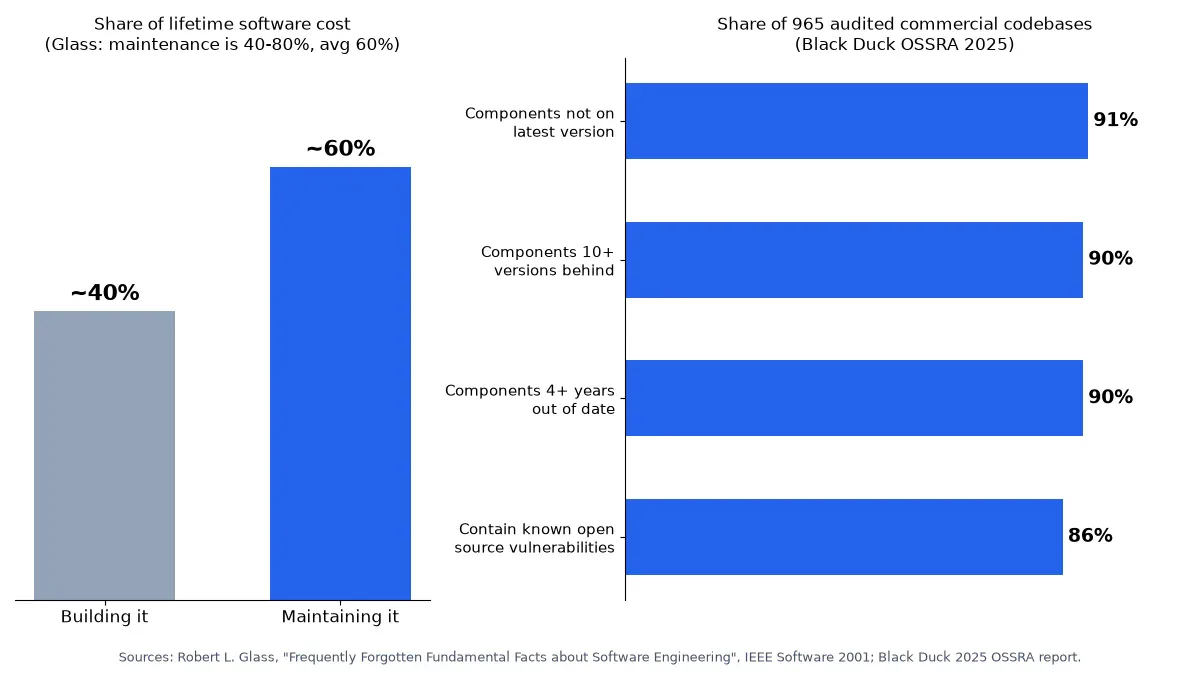
- Maintenance typically consumes 40 to 80 percent of software costs, about 60 percent on average.
- Roughly 60 percent of maintenance is enhancement, adding new capability. Fixing errors is about 17 percent.
He called it the "60/60 rule". It is old, but anyone who has run a product for a few years will recognise it. Most of the money goes in after launch, and most of that is not bug fixing. It is keeping the product useful as customers and the world around it change.
The developer side tells the same story. In Stripe's Developer Coefficient survey, developers said they spend about 17.3 hours of a 41.1 hour week on maintenance work such as debugging, refactoring, and dealing with technical debt. That is around 42% of their time.
Your code ages even when you do not touch it
Modern apps are mostly built from open source parts. That is normal and good, but those parts need updating, and most teams fall behind.
Black Duck's 2025 Open Source Security and Risk Analysis report audited 965 commercial codebases across 16 industries. It found that:
- 86% contained open source vulnerabilities, and 81% had high or critical risk ones.
- 90% had open source components more than four years out of date.
- 91% used components that were not on their latest version, and 90% had components more than 10 versions behind.
These are commercial products with paying customers, not hobby projects. Falling behind is the default. Catching up later is always more expensive than staying close, because big version jumps break more things at once.
The deadlines you do not get to choose
Some maintenance is optional. A lot of it is not. These are real dates from the last year that forced work on products whether their owners planned for it or not:
- Google Play. From August 31, 2026, new apps and app updates must target Android 16 (API level 36). Existing apps that target Android 14 or lower stop being available to new users on newer Android versions. Google calls this its regular yearly update, so expect another one next year.
- Apple App Store. Since April 28, 2026, apps uploaded to App Store Connect must be built with Xcode 26 and the iOS 26 SDK or later. If your app has not been rebuilt in a while, even a one-line fix can turn into an upgrade project.
- Node.js. Version 20 reached end of life on April 30, 2026. End of life means no more updates, including security patches. A lot of web backends launched in 2023 and 2024 run on it.
- SSL certificates. Under the CA/Browser Forum's Ballot SC-081v3, the maximum life of a public TLS certificate dropped to 200 days from March 15, 2026, falls to 100 days in March 2027, and to 47 days in March 2029. If renewals are not automated, someone will be renewing by hand a lot more often, and one missed renewal takes your site offline with a scary browser warning.
None of these are about adding features. They are the cost of staying in the app stores, staying patched, and staying online.
What maintenance actually covers
When founders hear "maintenance" they picture bug fixes. In practice it is a mix of five kinds of work:
- Keeping the lights on. Hosting, monitoring, backups, uptime alerts, certificate renewals, and responding when something goes down.
- Security and updates. Patching libraries, frameworks, runtimes, and servers. Watching for disclosed vulnerabilities in what you use.
- Platform changes. New iOS and Android versions, app store rules, browser changes, and third party APIs (payments, maps, email, login) that change or retire old versions.
- Fixes. Bugs your users find, edge cases you did not plan for, and data problems.
- Small improvements. The enhancements Glass talked about. Customers ask for things, and a product that never changes starts to lose to one that does.
There is also the bill that is not engineering time at all: cloud hosting, domains, email sending, error tracking, app store developer accounts, and paid APIs. Put those in the budget as their own line, so they do not hide inside "maintenance".
A simple way to budget for year one
There is no single correct number, and anyone who quotes you one without seeing your product is guessing. But you can get to a sensible first estimate with some plain arithmetic.
Take Glass's average: about 60% of lifetime cost is maintenance and 40% is the build. That means for every dollar spent building, roughly $1.50 gets spent maintaining it over its life. If you expect the product to live for five years, that is about 30% of the build cost per year.
So if your build cost $40,000, a rough planning figure is around $12,000 a year, or about $1,000 a month, plus hosting and third party services. That is an illustration from a long-run average, not a quote. A simple internal tool with ten users will usually need less. A customer-facing mobile app with payments and integrations will often need more.
Then sanity check it from the bottom up:
- Updates and patching: a few hours every month, plus a bigger block once or twice a year for major version upgrades.
- Mobile platforms: at least one planned update a year for each app store's new requirements.
- On-call and incidents: who answers when it breaks on a Saturday, and what that costs.
- Improvements: how many small changes you expect customers to ask for each month.
As a bug hunter I look at systems the way an attacker does. The weak spot is rarely the clever new feature. It is the library nobody updated, the server nobody patched, the certificate nobody renewed. Maintenance is where most of your security actually lives.
Signs your product is already behind
You may not need a full audit to know. Watch for these:
- Nobody on the team can say which versions of the framework, runtime, or database you run.
- Your last mobile release was more than a year ago.
- Deploying is a manual, nervous process that only one person knows how to do.
- You find out the site is down from a customer, not an alert.
- Small changes take weeks because "we need to upgrade some things first".
- Your original developer or agency is gone and nobody has access to everything.
If two or more of those sound familiar, the maintenance bill is already accumulating. It is just not being paid yet.
How we help
At Fionetix we build software for founders and SMBs in the US, UK, UAE, and beyond, and we look after a lot of software we did not build.
- Not sure where your product stands? Hourly consultancy is $30, and an hour or two is usually enough to check your versions, deadlines, and risks and give you a prioritised list.
- Want someone to keep it healthy? Our Software Maintenance retainer covers bug fixes, patches, dependency updates, and uptime and performance monitoring, at $1,899 a month or $499 a week. You can pause or cancel anytime.
- Starting fresh? Our Custom Software package ($1,999, about a month) is built with clean architecture and automated deployment, so keeping it updated stays cheap.
You own 100% of the code and IP from day one, whether we built it or not.
Put it in the plan now
Launch is the start of the product's life, not the end of the project. Add a maintenance line to your budget today, even a rough one. Write down your platform deadlines for the next twelve months. Make sure someone owns updates and alerts. It is far cheaper to keep software healthy than to rescue it.