

"We're too small to be a target"
It is one of the most common things founders say about security. It is also one of the most expensive assumptions you can make.
The logic sounds reasonable. Why would a serious attacker bother with a 20 person SaaS or a family-run distributor when there are banks out there? The data says the opposite. Most attacks are not aimed at you personally. They are automated, opportunistic, and they go wherever the door is open. Small companies tend to have more open doors.
I have spent more than ten years in full-stack development and security, including bug hunting (I am in Facebook's Hall of Fame for it) and building banking software and systems for the Bangladesh Navy and Army. The pattern is the same everywhere: the breaches that hurt are rarely clever. They come through the basics.
So here is the short list. What actually gets small companies breached, what it costs, and the handful of fixes that matter most.
What the 2025 data says about small businesses
The Verizon 2025 Data Breach Investigations Report analysed more than 22,000 security incidents, including 12,195 confirmed breaches. Its small and medium business snapshot is blunt:
- Ransomware was present in 88% of breaches at small and medium businesses, compared with 39% at large organisations.
- The use of stolen credentials was the top hacking method for both: 33% of SMB breaches and 32% at large organisations. Same attack, very different budgets to defend against it.
- Third-party involvement in breaches doubled, from 15% to 30% of all breaches.
- When secrets like API keys leaked into a GitHub repository, the median time to fix them was 94 days.
- Verizon also notes that SMBs are less likely to have up-to-date, readily available backups, which is exactly why ransomware works so well on them.
The UK government's Cyber Security Breaches Survey 2025 shows the other side of the problem, which is what businesses actually have in place:
- 43% of UK businesses reported a breach or attack in the previous 12 months, about 612,000 businesses.
- Only 40% of businesses require two-factor authentication, compared with 92% of large businesses.
- Only 14% formally review the security risks posed by their direct suppliers.
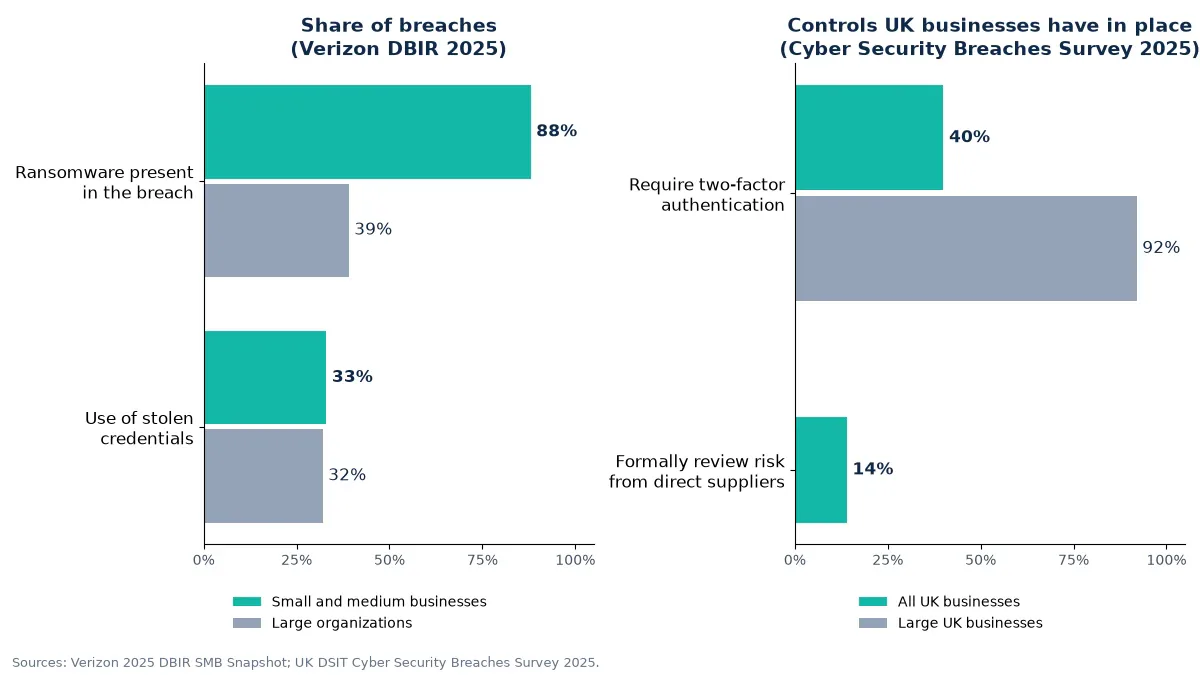
Put those together and the picture is clear. Attackers walk in with stolen passwords, through vendors, or through unpatched systems. Then they lock everything up and ask for money. And the controls that stop most of this are missing in more than half of businesses.
What a breach actually costs
The IBM Cost of a Data Breach Report 2025, based on 600 organisations studied by the Ponemon Institute, put the global average cost of a breach at $4.44 million. In the US it hit a record $10.22 million, driven partly by higher regulatory fines.
To be fair, those figures come mostly from larger organisations. A five-person agency will not get a $10 million bill. The UK survey found that the average cost of a business's most disruptive breach was £1,600, or £3,550 when you exclude businesses that reported no cost at all.
That sounds small. But the number on the invoice is rarely the real damage for a small company. The real damage is:
- Days of downtime while you restore systems, if you can restore them at all.
- Lost trust when you have to email customers saying their data was exposed.
- Lost deals when an enterprise buyer's security questionnaire asks "have you had a breach?" and you have to say yes.
- Founder time. Every hour spent on incident response is an hour not spent on the product or on sales.
For a SaaS company selling into the US, UK, or UAE, security is no longer just risk management. It is a sales requirement. Bigger customers will ask, and "we're too small to be a target" is not an answer they accept.
The short list: fix these first
You do not need a security team to get the basics right. You need a few weeks of focused work and someone who has done it before. Here is the order I would do it in.
1. Turn on MFA everywhere, and prefer an app over SMS
This is the single highest-return fix. A Microsoft Research study of business accounts found that MFA reduced the risk of account compromise by 99.22%, and by 98.56% even when the password had already leaked. The same study found authenticator apps outperformed SMS codes.
Start with the accounts that can do the most damage: email, cloud hosting (AWS, Azure, Google Cloud), your code repository, your domain registrar and DNS, payments, and your password manager.
2. Get secrets out of your code
API keys, database passwords, and cloud credentials do not belong in source code, Slack messages, or shared documents. Remember the 94 days it took, at the median, to fix secrets leaked in GitHub repositories.
- Store secrets in your cloud provider's secret manager or a proper vault.
- Turn on secret scanning in your repository (GitHub and GitLab both offer it).
- When a secret leaks, rotate it the same day. Deleting the commit is not enough.
3. Patch what faces the internet first
Verizon found exploitation of vulnerabilities was the initial way in for 20% of breaches, up 34% from the previous year, with a heavy focus on VPNs and other edge devices. You cannot patch everything at once, so start with what the internet can reach: VPNs, firewalls, web servers, CMS plugins, and any old admin panel or staging server you forgot about.
Make a list. If you do not know what you have exposed, that is the first problem to fix.
4. Have backups that ransomware cannot touch
With ransomware in 88% of SMB breaches, your backups are your real insurance policy. A backup only counts if:
- At least one copy is offline or immutable, so an attacker with admin access cannot delete it.
- It is separate from your main accounts, so one compromised login does not reach both.
- You have actually tested a restore in the last few months. An untested backup is a hope, not a plan.
5. Know which vendors can touch your data
Third-party involvement doubled to 30% of breaches, yet only 14% of UK businesses review their direct suppliers' risk. You do not need a 200-question vendor assessment. Start with a simple list:
- Every SaaS tool and contractor with access to customer data or production systems.
- What access each one has, and whether it needs that much.
- Who removes access when someone leaves or a contract ends.
6. Keep work logins off unmanaged personal devices
Verizon looked at infostealer malware logs and found that 46% of compromised systems holding corporate logins were non-managed devices, likely personal laptops with both personal and work credentials on them. And 54% of ransomware victims had their domains show up in those credential dumps.
At minimum, keep work accounts in a separate browser profile, require a password manager, and avoid letting company admin accounts live on a family computer.
7. Write a one-page rule for AI tools
Your team is already pasting things into AI tools. IBM found that 20% of organisations in its study suffered a breach involving "shadow AI", meaning AI tools used without approval. Organisations with high levels of it saw $670,000 higher breach costs on average. And 97% of organisations that reported an AI-related breach lacked proper AI access controls.
You do not need to ban AI. Just decide which tools are approved, what data must never go into them (customer personal data, credentials, unreleased financials), and who can connect AI tools to company systems.
When I look at a system the way an attacker would, I do not start with anything clever. I look for the forgotten staging server, the admin account without MFA, the API key sitting in an old commit. That is where small companies get hurt.
What can wait
Security vendors will happily sell a 20 person company the same stack as a bank. Most of it can wait until the basics above are done:
- A 24/7 security operations centre. Useful later. Not before MFA and backups.
- An expensive penetration test. Worth it once the basics are in place. Before that, it mostly tells you things this list already covers.
- A large, enterprise-grade monitoring platform. Start with centralised logs and alerts on admin logins and unusual access. Grow from there.
- Every certification at once. Get one when customers ask for it. UK buyers may ask for Cyber Essentials, and US enterprise buyers often ask for SOC 2. The basics above make either one much easier.
How we help
At Fionetix, security is built into the work, not added at the end. If you want the basics above done properly without hiring a security team:
- Our Legacy Fix & Server package ($1,999) covers diagnosing and fixing issues, performance and security hardening, and server setup and management, with a documented handover.
- Our Software Maintenance retainer ($1,899 a month, or $499 a week) keeps things patched with bug fixes, patches, dependency updates, and uptime monitoring. You can pause or cancel anytime.
- Not sure where you stand? Hourly consultancy starts at $30, which is a cheap way to get an honest review of your setup.
You keep 100% of the code and IP from day one.
Start with one hour this week
Pick one hour this week. Check which of your critical accounts have MFA, when you last tested a backup restore, and which vendors can reach your customer data. Write down what you find.
Most founders find at least one thing that makes them uncomfortable. That is good news. It means you found it before someone else did.