

The feature list is the problem
Almost every founder who asks me for an MVP quote sends a feature list. It usually has 30 to 60 items. Login with Google and Apple. An admin dashboard. Notifications by email, SMS, and push. Roles and permissions. A referral program. Analytics. Dark mode. Sometimes an AI assistant "because investors will ask".
Each item makes sense on its own. Together they are not a minimum viable product. They are version three, and you are trying to pay for it before you know if anyone wants version one.
I have been building software for over ten years, from banking systems to platforms for the Bangladesh Navy and Army, and for startups in the US, UK, and UAE. The pattern I see most often is not bad engineering. It is a good team building the wrong amount of product.
Most features never get used
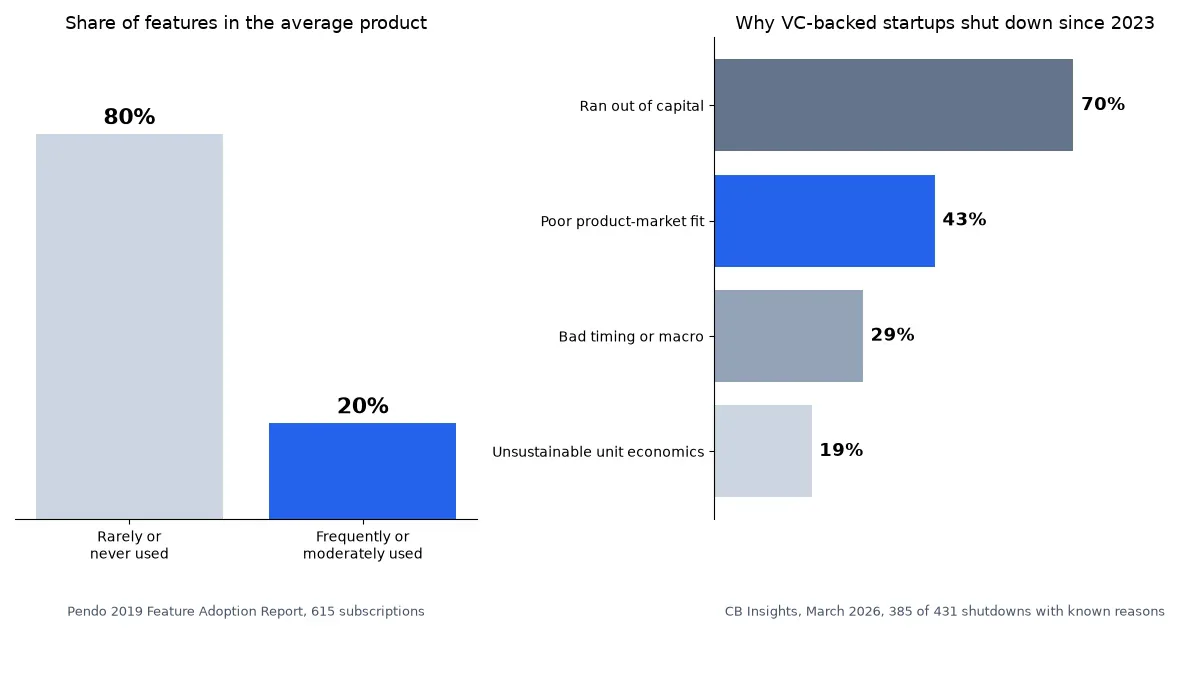
In its 2019 Feature Adoption Report, Pendo looked at anonymized usage data across 615 software products over three months. They found that 80% of features in the average product are rarely or never used, and that just 12% of features generated 80% of daily usage.
Those are mature products with real teams and real customers. Your MVP will be no different. Most of what is on your list will sit there, costing money to build, test, and maintain, while a handful of screens do all the work.
The difference is that a mature company can afford that waste. A founder spending their own savings or a seed round usually cannot.
Running out of money is how most startups end
CB Insights analyzed 431 VC-backed startups that shut down since 2023 and published the results in March 2026. Of the 385 where the reasons were clear:
- 70% ran out of capital.
- 43% had poor product-market fit.
- 29% blamed bad timing or the wider market.
- 19% had unit economics that did not work.
CB Insights makes a point I agree with: running out of cash is almost always the final cause, not the root one. The money ran out because the product did not find its market fast enough. An oversized MVP makes that worse in two ways. It burns more of the runway before launch, and it takes longer to learn whether the core idea works at all.
Find the one job your MVP must do
Before you cut anything, write one sentence:
"A [specific user] can [do one thing] so that [they get one result], and today they do it by [current workaround]."
For example: "A property manager with 20 to 200 units can collect maintenance requests with photos in one place, so that nothing gets lost in WhatsApp, and today they do it with a shared inbox and a spreadsheet."
If you cannot write that sentence, you are not ready for a build quote. You are ready for a few customer conversations. If you can write it, every feature on your list now has a simple test: does it help that user do that one thing on day one?
The cut list
These are the features I most often move out of version one. None of them is bad. They are just not the reason anyone will pay you yet.
Cut or fake for now
- Admin dashboards. For the first 50 customers, a protected spreadsheet export or a basic internal page is enough. You can see your data in the database.
- Multiple login methods. Pick one. Email magic link or Google is usually plenty.
- Complex roles and permissions. Start with "owner" and "member". Add more when a paying customer asks.
- Notifications on every channel. Email first. SMS and push when you know which events people actually care about.
- Referral programs, loyalty points, gamification. Growth features need something to grow. Ship the core first.
- Native apps on both iOS and Android. A responsive web app or a single cross-platform app tests the idea at a fraction of the cost.
- In-house analytics. Use an off-the-shelf tool for now.
- "AI-powered" anything that is not the core job. If AI is not what the customer pays for, it can wait.
Do it by hand first
Some features are better done manually until you know they matter. Onboarding calls instead of an onboarding wizard. Invoices sent from your accounting tool instead of a custom billing engine. A person reviewing flagged items instead of an automated moderation system. If doing it by hand starts to hurt, that is the signal to build it, and by then you will know exactly how it should work.
Never cut these
Cutting scope does not mean cutting corners. Some things stay in version one no matter what:
- Security basics. Proper authentication, encrypted connections, sensible access control, and no secrets in the code. Fixing a breach costs far more than doing this right.
- Backups and a way to restore them.
- Error logging, so you know when something breaks before a customer tells you.
- Clean, documented code that you own. An MVP is the foundation for version two. If it has to be thrown away, you paid twice.
- Anything legally required in your market, such as data protection basics for UK and EU users.
A one-page scope that keeps creep out
Once you have the one-sentence job and the cut list, put the scope on a single page:
- The job. The one sentence from above.
- The core flow. The five to eight screens or steps a user goes through to get the result.
- In scope. Only what that flow needs.
- Not in version one. Everything you cut, written down so it is parked, not forgotten.
- How we will know it works. One or two numbers, for example "10 paying customers" or "30% of trial users complete the core flow in week one".
- Budget and deadline. Fixed. If something new comes in, something else goes out.
That last rule is the one that saves projects. Scope creep rarely arrives as one big change. It arrives as ten small "while you are in there" requests. A written "not in version one" list makes it easy to say "great idea, it goes on the list for version two."
The best MVPs I have worked on felt a little embarrassing to launch. The founders wanted more in them. Then customers started using the one thing that mattered, and the feedback told us what to build next far better than any feature list could.
How long should an MVP take?
It depends on the product, but if your scope is tight, a focused team can usually get a working first version in front of real users in roughly four to eight weeks. If your estimate is six months, that is often a sign the scope is still too big, not that the team is too slow.
How we help
At Fionetix we help founders in the US, UK, UAE, and beyond turn a long wish list into a first version that ships.
- Not sure what to cut? Hourly consultancy starts at $30, and a short scoping session is often enough to turn 40 features into the 10 that matter.
- Thinking about AI in the product? Our AI Consultancy & Learning package ($999) includes an AI opportunity audit and roadmap, so you only build the AI that earns its place.
- Ready to build? Our Custom Software package ($1,999, about a month) delivers a production-ready application with clean architecture, which fits a well-scoped MVP.
- After launch, our Software Maintenance retainer ($1,899 a month, or $499 a week) covers fixes, updates, and the next round of features.
You own 100% of the code and IP from day one.
Do the exercise this week
Write your one-sentence job. Go through your feature list with the cut list above. Put what is left on one page. If it still does not fit in a few weeks of work, cut again. You will launch sooner, spend less, and learn faster, which is the whole point of an MVP.