

The offer letter is only the first line
A founder sends me two numbers. A US job post at $130,000, and a freelancer at $25 an hour. The conclusion arrives in the same message: hiring is insane, outsourcing is obvious.
Sometimes that conclusion is right. Often the two numbers are not the same kind of thing, so the comparison cannot be right yet.
I have spent more than ten years on this, building banking software and software for the Bangladesh Navy and Army, and shipping product for founders in the US, UK, and UAE. I still do hands-on client work, including as an Upwork Top Rated Plus freelancer and a Meta Hall of Fame bug hunter. The pattern is steady. People compare a salary with an hourly rate, then get surprised by payroll tax, a quiet month, or a resignation in month nine.
This post puts public numbers under the salary. Every figure below is either copied from a cited source or calculated from one, and the calculations are shown. Where I use an example, it is labeled as an example. These are planning figures for a founder, not a quote for your next hire, and not tax, legal, or pension advice.
What fully loaded cost includes
Fully loaded means every dollar, pound, or dirham the company pays because that person is on the team. Salary is the large line. It is not the only line.
- Cash pay. Wage, or in the UAE often a fixed monthly package of basic salary plus allowances.
- Employer taxes. US Social Security, Medicare, and unemployment tax. UK employer National Insurance. The UAE does not levy income tax on individuals.
- Retirement that the law already priced in. UK workplace pension at the minimum. UAE end-of-service gratuity for a foreign worker. A US 401(k) match only if you choose to offer one.
- Benefits you choose. Health insurance, paid leave, equipment, software.
- Recruiting. Fees, ads, and your own hours before the person starts.
- Ramp and management. Paid time while they learn the product, and your time reviewing their work.
- Attrition. The chance you pay the search again.
- Idle time. Pay that continues when the backlog does not.
Some of those have a public price. Some do not. I will not fill the gaps with a percentage I cannot cite.
United States: median pay plus the taxes you cannot skip
The latest BLS Occupational Outlook Handbook figure, from the May 2025 Occupational Employment and Wage Statistics survey, puts the median annual wage for software developers (SOC 15-1252) at $135,980. The same table puts the 10th percentile at $82,460 and the 90th at $214,670. The mean is $148,100. About 1,687,890 people were employed in the occupation. The OEWS news release shows the same median hourly wage, $65.38, and the same mean annual wage.
That wage is from May 2025. The tax rates below are the 2026 rules, applied to that wage as a planning sum. A 2026 offer in a costly city can sit well above the median. Use your real offer in the last section.
IRS Publication 15 for 2026 sets the employer pieces:
- Social Security tax is 6.2% of wages, up to the $184,500 wage base. The Social Security Administration publishes the same 2026 base.
- Medicare tax is 1.45% of all wages, with no wage cap. The extra 0.9% Medicare tax on high earners is the employee's, not yours.
- FUTA is 6.0% of the first $7,000 of wages. If you pay state unemployment tax in full and on time, and your state is not a credit-reduction state, the credit can be as much as 5.4%, which leaves a 0.6% net FUTA rate. Publication 15 says to figure the deposit at 0.6% in that common case.
On the $135,980 median, which is under the Social Security cap:
- Employer Social Security: 0.062 x 135,980 = $8,430.76
- Employer Medicare: 0.0145 x 135,980 = $1,971.71
- FUTA after the full credit: 0.006 x 7,000 = $42.00
- Employer payroll tax: $10,444.47
- Wage plus that tax: $146,424.47
State unemployment tax and workers' compensation sit on top of the $42, and both vary by state and by your claims history. I am not going to invent a national average for them. Federal law also does not force a very small company to offer health insurance or a retirement plan the way UK law forces National Insurance. The moment you do offer them, they belong in the budget. So does a laptop, payroll software, and any paid leave your state requires.
There is a separate BLS measure for what employers actually spend, and it is much larger than payroll tax, because it includes companies that do offer those benefits.
In the June 2026 Employer Costs for Employee Compensation release, private-industry workers in professional and related occupations cost employers $73.69 an hour. Wages and salaries were $50.98 (69.2% of the total). Benefits were $22.71 (30.8%), covering paid leave, supplemental pay, insurance, retirement, and legally required benefits.
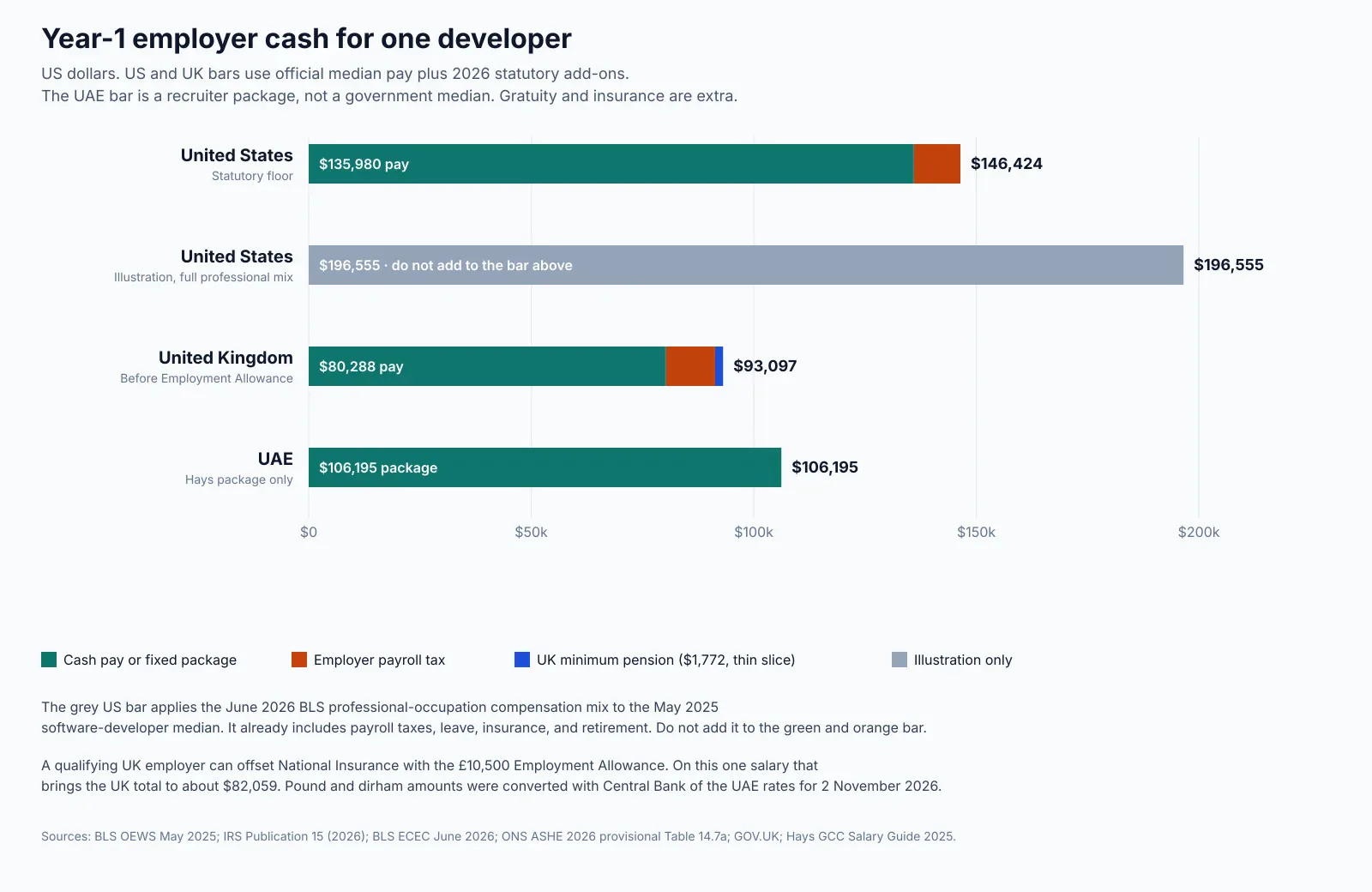
Wages in that row were $50.98 out of $73.69. Apply that same ratio to the software-developer median: 135,980 x (73.69 / 50.98) = $196,554.85. The slice above wages is 196,554.85 - 135,980 = $60,574.85. Legally required benefits in that table are 6.5% of compensation, so the $10,444.47 of federal payroll tax calculated above sits inside the $196,554.85. Add the two totals and you will count payroll tax twice.
A five-person company that offers a modest health plan will usually land between $146,424 and $196,555. A company that offers little beyond salary will land near the lower number, plus state unemployment and workers' compensation.
United Kingdom: National Insurance, pension, and a small-employer allowance
The ONS Annual Survey of Hours and Earnings, 2026 provisional, Table 14.7a, full-time employee jobs, puts median gross annual pay for programmers and software development professionals (SOC 2020 code 2134) at £59,862.50. The 25th percentile is £43,509.40 and the 75th is £82,148.70. The mean is £69,120.60. The same survey's all-employee full-time median, from the 2026 earnings bulletin, is £40,911.
Two limits on that median. The 2026 estimates are provisional, and ONS will revise them. Annual ASHE pay also describes employees who had been in the job for at least a year, and it can include bonuses, overtime, and pay affected by absence. It is a strong official benchmark. It is not a graduate starting offer.
Employer National Insurance for 2026 to 2027 is on GOV.UK. For a standard category A employee, the employer rate is 15% on earnings above the £5,000 secondary threshold.
Using the annual threshold as a shortcut (payroll actually works this out each pay period, so the year's bill can differ by about a pound):
- 0.15 x (£59,862.50 - £5,000) = 0.15 x £54,862.50 = £8,229.375, which is £8,229.38 to the nearest penny
The legal minimum pension is separate. GOV.UK says the employer minimum is 3% of qualifying earnings, the employee minimum is 5%, and the total minimum is 8%. For 2026 to 2027, The Pensions Regulator sets qualifying earnings from £6,240 to £50,270 a year. The government's review kept those same band edges. This median salary is above £50,270, so the employer minimum is calculated on the whole band:
- 0.03 x (£50,270 - £6,240) = 0.03 x £44,030 = £1,320.90
Year-1 cash before any allowance:
- £59,862.50 + £8,229.38 + £1,320.90 = £69,412.78
Salary sacrifice can also change the NI bill. I have not adjusted the figures for it, because it depends on the scheme.
United Arab Emirates: a tax-free salary, then gratuity and insurance
The UAE government portal states that the UAE does not levy income tax on individuals. For a foreign worker in the private sector, you also do not pay a US-style or UK-style employer social security contribution. The structural costs show up as the monthly package, end-of-service gratuity, health insurance, and the work permit.
There is no ONS or BLS equivalent I can cite for UAE developer pay. The figure I will use is a recruitment-market number, and it is not comparable one-for-one with the US and UK medians. The Hays GCC Salary Guide 2025 publishes total fixed monthly packages in dirhams as of the fourth quarter of 2024, drawn from Hays listings, offers, candidate registrations, and a survey of 1,028 employers and 925 employees. Averages are rounded to the nearest AED 500.
For the UAE, that guide shows:
- Full stack developer: AED 25,000 to AED 40,000 a month, average AED 32,500
- Back end developer: AED 20,000 to AED 35,000 a month, average AED 27,500
- Front end developer: AED 20,000 to AED 35,000 a month, average AED 27,500
A year at the full stack average is 32,500 x 12 = AED 390,000. A year at the front end or back end average is AED 330,000. The published range for full stack runs from AED 300,000 to AED 480,000 a year.
The dirham peg is 1 USD = AED 3.6725, stated on the UAE government fact sheet. At that rate the full stack average is 390,000 / 3.6725 = $106,194.69 a year. The front end and back end average is 330,000 / 3.6725 = $89,857.05. The full stack range is about $81,688 to $130,701.
Gratuity is extra, and it is not 21 days of that package. Article 51 of Federal Decree-Law No. 33 of 2021 gives a foreign full-time worker, after at least one year of continuous service, end-of-service gratuity on basic wage: 21 days' basic wage for each of the first five years, then 30 days for each year after that. Parts of a year count once the first year is complete. Unpaid absence does not count. The total cannot exceed two years' wage. The government's explainer is explicit that housing, transport, and similar allowances are outside the basic salary used for the calculation. An Emirati worker's end-of-service benefit follows the pension and social security rules, not this 21-day formula.
Health insurance is a real line, and the legal floor is smaller than most founders fear. The UAE government health insurance page says employers in Abu Dhabi cover employees and eligible family members, and employers in Dubai cover employees. From 1 January 2025, a health insurance policy is also required to issue or renew residency for private sector employees, starting with Abu Dhabi and Dubai and extending to the other emirates. The same page prices the basic package at AED 320 a year. That is the basic package, not the richer plan a software developer is often offered. Budget the premium your insurer actually quotes. Keep AED 320 as the floor.
Work permit and residency fees depend on the permit type. Take them from the current MOHRE schedule rather than from a blog. They are small next to AED 390,000, and they are still a line.
The three countries side by side
The chart rounds each calculated dollar amount to the nearest dollar. The table keeps the cents so you can trace the arithmetic. Pound and dirham conversions use Central Bank of the UAE rates for 2 November 2026: one US dollar at 3.6725 dirhams, one pound at 4.925563 dirhams. That is 4.925563 / 3.6725 = about $1.3412 per pound.
| Line | United States | United Kingdom | UAE, foreign worker |
|---|---|---|---|
| Cash pay used here | $135,980 BLS median wage, May 2025 | £59,862.50 ONS median, April 2026 provisional | AED 390,000 a year, Hays full stack average package, Q4 2024 |
| Employer tax | $10,444.47 Social Security, Medicare, and FUTA after the full credit | £8,229.38 National Insurance before allowance | No personal income tax |
| Retirement floor | None required in this federal sum | £1,320.90 minimum pension | Gratuity on basic wage, paid at the end. See the example above |
| Year-1 total in local currency | $146,424.47 before state unemployment, workers' compensation, and any benefits you add | £69,412.78 before allowance, or £61,183.40 if the allowance clears the NI | AED 390,000 package, before gratuity, insurance, and visa fees |
| Same total in US dollars | $146,424.47 | $93,096.53 before allowance, or $82,059.28 with it | $106,194.69 |
Read the columns as three different statistics that happen to describe a developer. The US and UK rows are official medians for employees, plus rules I applied. The UAE row is a recruiter average for a total fixed package, from an earlier quarter, and it already mixes basic pay with allowances. The direction is still useful. A median US employee has a federal cash floor around $146,000 before the benefits a competitive offer usually includes. A median UK employee is about £69,000 before Employment Allowance, and closer to £61,000 for a qualifying small employer. A UAE full stack package at the Hays average is about $106,000 before gratuity and a real insurance plan, and a front end or back end average in the same guide is about $90,000.
Recruiting cost and the weeks before anyone starts
Salary starts when they start. The search starts earlier.
SHRM's 2025 benchmarking release put the average cost-per-hire at $5,475 for nonexecutive roles and $35,879 for executive roles. The survey ran from 9 January to 3 March 2025 and had 2,371 responses from SHRM members in the United States. It is an all-role average, not a software-developer average. A search that goes through a specialist agency often costs more than $5,475. I will not invent the agency percentage.
SHRM's 2026 recruiting benchmarking brief says the median time-to-fill for nonexecutive positions has fallen to 39 calendar days. That is the wait until the seat is accepted. It is not the wait until the person is useful. During those days you are usually not paying their salary yet. You are paying with delay, with your own evenings, and sometimes with a contractor bridging the gap.
Ramp, management, and the quiet months
I am not going to quote a universal "months to full productivity" number. The studies people pass around are usually about billable consultants, not about a developer inside a product company, and the range is too wide to pretend there is one figure. What I will say from delivery work is simpler.
The first stretch is paid learning. They are learning your customers, your data, and the way you deploy. A senior still needs that. A junior needs that plus a manager. If the manager is you, the hire is spending your selling time. I wrote a separate piece on why a junior developer is often the expensive hire, even when the salary looks kind.
Idle time is the line salary surveys never show. An employee is paid in a quiet month. A scoped build is not, and a retainer you can pause is not. If your real need is a launch, then a trickle of fixes, a permanent seat bills you for the trickle at the full monthly rate. That is a fair trade when the person is also holding customer knowledge you cannot afford to lose. It is a poor trade when the backlog is a project with an end.
Attrition means you may pay the search twice
The BLS Job Openings and Labor Turnover release for August 2026, seasonally adjusted, put the quits rate at 1.1% in the information sector and 2.1% in professional and business services. The quits rate is the number of quits in the month divided by employment. It is not the probability that your one developer resigns this year. Information also covers more than software companies.
The founder version is enough. Over a few years, a resignation is a normal event in this work, not a freak accident. When it happens you pay the search again, you pay the ramp again, and you hope the system is understandable without them. That last hope is a paperwork problem. If the repo, the cloud account, and the domain are in their name, the replacement cost is the least of it. The IP and access checklist is the same list whether the person was an employee or a vendor.
When hiring in-house is the right call
Hire when the work is the company, and it does not pause.
- The product changes every week, and the person doing it needs to sit with customers, not with a ticket queue.
- You already have someone technical who can review code. A lone developer with no reviewer is how quiet architectural debt starts.
- The knowledge you care about is your operation, and you want it on payroll for years.
- The backlog is steady across the year. You can look at the next four quarters and see a full-time job, not a three-month spike.
- You can carry the fully loaded number, a vacant month during the search, and another search if they leave.
In that situation, a US statutory floor near $146,000, or a UK cost near £61,000 to £69,000, or a UAE package near the Hays range, can be the correct buy. You are buying continuity.
When an outsourced or offshore team is the right call
Use an outside team when you need an outcome more than you need a seat.
- The next six months of work is a product, a migration, or a repair, and you can describe the end.
- You do not have a technical lead, so a junior hire would report to you. That is the expensive version of "cheap."
- You need a back end, a small admin UI, and someone who can deploy it. That is three skills. Hiring three people to get them is how early teams go broke.
- The load is lumpy. A launch, then care and feeding.
- The in-house floor is larger than the thing you are trying to ship this year.
Offshore does not change those tests. It changes the price of the hours, and it adds a management job if you buy the hours raw. A low rate with no senior review, no written scope, and no repo in your company's name is how a "cheap team" becomes a rewrite. I compared that body-shop pattern with a senior, AI-assisted partner in a separate post. The practical fix, whoever you hire, is a spec the team can build against. We wrote up how we do that in spec-driven development.
A rate check, labeled as arithmetic rather than a package. At the $30 an hour consultancy rate on Fionetix services, 40 hours is $1,200. An example full-time year of 52 weeks times 40 hours is 2,080 hours, and 2,080 x $30 is $62,400. We do not sell a 2,080-hour block, and an invoice for hours is not the same thing as an employee who lives inside the company. It does show the gap against a $146,424 US statutory floor, a £69,413 UK bill, or a $106,195 UAE package. The gap is the point of outsourcing. The gap closes if you spend your own weeks managing the work.
One legal edge, not a legal opinion. If you direct a contractor the way you direct an employee, tax authorities may treat them as an employee. Scope, deliverables, and a real company on the other side of the contract matter. Get advice in the country where you employ people.
Founders in Bangladesh often hit this from the other direction. A client in the US, UK, or UAE is deciding whether to hire locally or keep the work with a team here. The same sheet helps. Price your offer against their fully loaded seat, and against the cost of their time managing you, not against a salary screenshot alone.
Run the numbers for your company
The medians above are a starting point. Your offer is the one that matters.
- Write the salary or package you would actually put in the contract. Use the BLS, ONS, or Hays figures only as a sense check.
- Add the employer tax from the rules above. In the UK, then ask whether Employment Allowance is still available.
- Add the benefits you will really offer, not the benefits a big-company survey assumes. In the UAE, split basic salary from allowances before you estimate gratuity.
- Add a recruiting budget. $5,475 is a US all-role average, useful as a floor for the direct costs, not as your number.
- Add your own hours, at a value you believe.
- Ask what the third quiet month costs, and what month nine costs if they resign.
- Put a scoped price for this year's actual work next to that total. Compare the seat with the work.
If step 7 is a defined build, the main Fionetix site is the company behind the delivery, and the service menu is the price list. Hourly consultancy is $30. The Custom Software package is $1,999 and is meant to land a production-ready application in about a month. If you already have a product and you need it kept healthy without opening a full-time seat, the maintenance retainer is $1,899 a month or $499 a week, and you can pause it. You keep 100% of the code and IP.
A practical next step
Pick the option that matches the shape of the work. A steady product with a reviewer on the team is a hire, and the hire should be budgeted at the fully loaded number, not the salary. A launch, a repair, or a year of uneven work is usually a scoped team, priced against that same fully loaded number so you can see what you are not spending.
If you want those lines filled in against your actual backlog, one or two hours is enough to say which way the math leans.
I have been the in-house engineer and I have been the outside team. The founders who do well are the ones who buy continuity when the work is permanent, and who buy a finished outcome when it is not. The salary on the offer letter is never the whole decision.