

The quote you got last week is probably a guess
A founder sends three agencies the same two-page brief. A week later they have three quotes: $18,000, $45,000, and $120,000.
They pick the middle one. It feels safe.
Four months in, the "simple" admin panel needs role-based permissions nobody mentioned. The payment flow has to handle refunds and partial payments. The CRM integration turns out to need a paid API tier. The budget is gone, the launch date has moved twice, and both sides feel cheated.
Nobody lied. The quote was just written before anyone understood the problem. All three numbers were guesses, and the founder had no way to tell which guess was closest.
That is the job of discovery. Not a fancy deliverable, not a month of meetings. A short, focused piece of work that turns "build me an app like X" into something a team can actually price and build.
What the numbers say about skipping it
This is not a small-company problem, and it is not new.
PMI's 2014 Pulse of the Profession research found that inaccurate requirements gathering was a primary cause of project failure for 37% of organizations. In a follow-up study on requirements management, PMI found that when projects missed their original goals, poor requirements management was the primary cause 47% of the time.
At the larger end, McKinsey and the University of Oxford studied a database of more than 5,400 IT projects. For projects budgeted above $15 million, the average result was a 45% cost overrun, a 7% schedule overrun, and 56% less value than predicted. Software projects carried the highest risk of overruns.
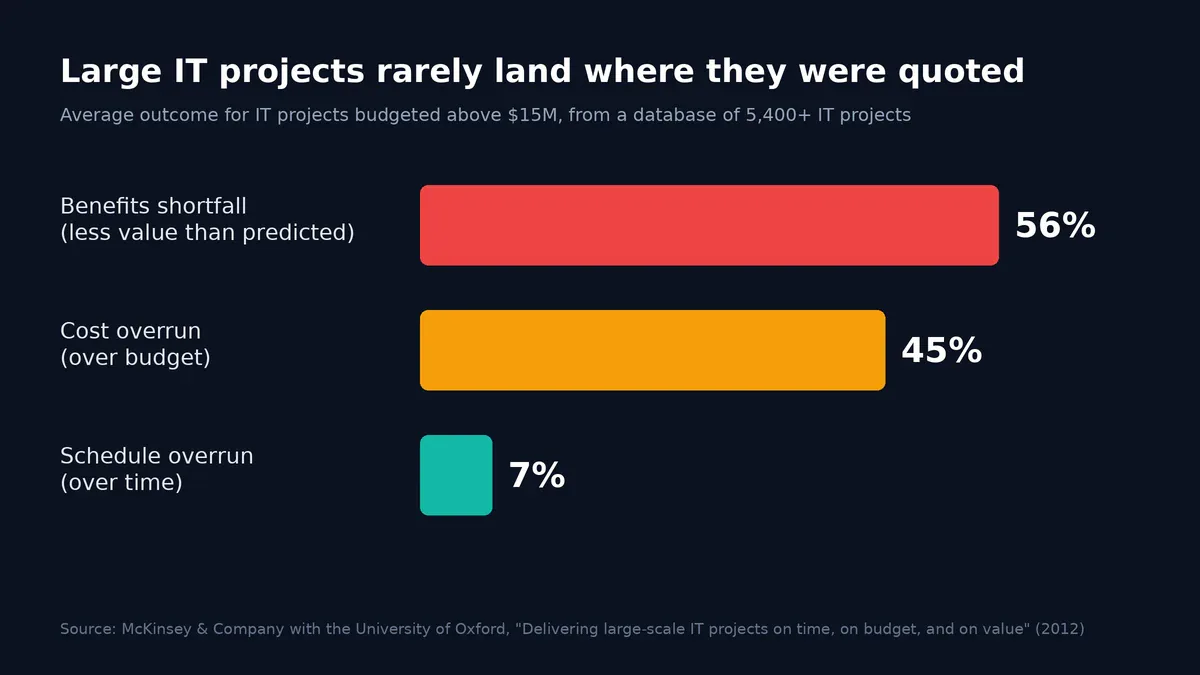
Your MVP is not a $15 million program. But the pattern scales down. When the scope is fuzzy, the quote is fiction, and the cost of that fiction shows up later as change requests, rework, or a rebuild.
Discovery is not a sales call
A free 30-minute call is useful. It tells you whether a team is worth talking to. It is not discovery.
On a sales call, the vendor is trying to win the deal. In real discovery, they are trying to understand your business well enough to tell you what not to build. Those are different goals, and you can usually feel the difference.
That last point is why I think founders should pay for discovery, even a small amount. When it is free, the output usually belongs to the sales process. When you pay for it, the output belongs to you.
What a real discovery actually covers
Good discovery does not need to take a quarter. For most MVPs and internal tools, a few focused days is enough. What matters is that it covers six things.
1. Business goals and success metrics
What has to be true in six months for this project to be worth the money? More bookings, fewer support tickets, a demo for investors, replacing a spreadsheet that three people fight over? If nobody can name the metric, nobody can make good tradeoffs later.
2. Real workflows, step by step
Not "users manage orders." Who creates the order, who approves it, what happens when it is cancelled, who gets notified, and what they do today without software. This is where most hidden scope lives. Sitting with the person who actually does the work for an hour is worth more than a week of guessing.
3. Data
What data exists already, where it lives, how messy it is, and who owns it. Migrating 40,000 customer records from an old system is often a project of its own. Personal or financial data also brings privacy rules like GDPR in the UK and EU, US state privacy laws, or the UAE's Personal Data Protection Law, which shape the architecture from day one.
4. Integrations
Payment gateways, CRMs, accounting tools, shipping, email, identity providers, legacy systems. Each one has its own API limits, pricing tiers, and quirks. One unknown integration can move a quote more than the entire user interface.
5. Risks and unknowns
What could sink this? A third-party API that might not support what you need. A compliance requirement. A performance target. Good discovery names these early and, where it can, runs a small spike to test the scariest assumption before you commit real money.
6. Non-goals
This is the one most teams skip, and it is the one that protects your budget. A written list of what version one will not do. No mobile app yet. No multi-currency. No custom reporting builder. Every item on that list is a future argument you have already settled.
What you should walk away with
At the end of discovery, you should hold a small set of documents. Not a 60-page specification. Something closer to this:
- A one-page problem statement. Who the users are, what pain you are solving, and how you will measure success.
- Must-haves vs later. A prioritized feature list split into version one and everything else, with the non-goals written down.
- A rough architecture sketch. Main components, where data lives, which third-party services are involved, and how they connect. A diagram on one page is fine.
- A risk list. The top unknowns, how likely each is, and what you will do about it.
- A ballpark range, with assumptions. Not a single magic number. A range, plus the assumptions behind it, so you can see exactly what would push it up or down.
With those five things, you can get comparable quotes from different teams, because everyone is now pricing the same product. You can also cut scope intelligently when the number is too high, instead of cutting quality by accident.
The cheapest line of code is the one you decided not to write. Most of the savings in a project are found in the first few days, on a whiteboard, long before anyone opens an editor.
Red flags in a discovery offer
Discovery can be done badly too. Be careful when you see:
- No fixed end date. "We will keep exploring until we understand everything" usually means billing until the budget runs out.
- Only a price at the end. If there is no written scope, architecture sketch, or risk list, you paid for a quote.
- No one technical in the room. If the only person asking questions is in sales, nobody is testing whether your ideas are buildable.
- They never push back. A team that agrees with every feature on your wish list is not doing discovery. They are taking an order.
- You cannot keep the output. The documents should be yours to take anywhere. If the deliverables only make sense inside their tools, that is a lock-in tactic.
How long and how much?
It depends on the size of the problem, but here is a sensible rule of thumb from what I have seen across banking, defense, and startup projects over the last ten years:
- Small MVP or internal tool: one to three days of focused work.
- Product with several integrations or a legacy system: one to two weeks.
- Large or regulated systems: longer, often run in phases, with a spike or prototype included.
As a budget sanity check, discovery should be a small fraction of the build. If it starts to look like a project of its own, ask why.
If you are dealing with an older system, discovery is also where you decide whether to repair it or start over. I wrote more about that call in Rewrite or Refactor? How Founders Should Decide What to Do With Legacy Software. And once you do pick a team, make sure the repos and accounts are in your name from day one. Here is my IP and access checklist for founders.
How we run discovery at Fionetix
We are not fans of endless discovery either. Our default is a day or two of strict scoping before any build: goals and KPIs, workflows, data model, integrations, risks, and a written list of non-goals. Then we commit to a plan.
For a lot of founders, that leads straight into our Custom Software package, a production-ready app delivered in about a month. For bigger or messier projects, with complex integrations, legacy systems, or enterprise data, we scope it properly first and quote from that. If you only want a second opinion on a quote you already have, a single hour of consultancy is often enough to spot what is missing.
Either way, the documents are yours, and so is the code.
Pay a little now, or a lot later
Discovery feels like a delay when you are excited to build. It is actually the fastest route to a launch that does not slip, because it moves the hard conversations to the start, when they cost a whiteboard marker instead of a rewrite.
Before you sign the next build quote, ask one question: "What exactly is this number based on?" If the answer is a two-page brief and a call, you know what to do.