

The demo is the easy part
Every founder I talk to about AI agents has seen a great demo. The agent answers questions, looks things up in the CRM, drafts the reply, maybe even books the meeting. It takes a few days to build and everyone in the room is impressed.
Then someone asks the real questions. What happens when a customer asks something it was never trained on? What stops it from issuing a refund it should not? Who gets paged when it starts looping at 3 a.m. and burns through the API budget?
That gap between "it works in the demo" and "I trust it with customers" is where most agent projects quietly die. I have spent over ten years building software where mistakes are expensive, including banking systems and software for the Bangladesh Navy and Army, and the lesson carries over directly. The clever part is rarely what breaks. The missing boring part is.
This post is the boring part. It is the checklist I go through with founders before an agent touches production.
Why so many agent projects get canceled
In June 2025, Gartner predicted that over 40% of agentic AI projects will be canceled by the end of 2027. The reasons they gave were escalating costs, unclear business value, and inadequate risk controls.
Gartner also estimated that only about 130 of the thousands of vendors selling "agentic AI" are offering real agents. The rest are rebranded chatbots and automation tools. Their advice was blunt: many use cases sold as agentic do not need an agent at all.
The builders themselves say something similar. LangChain's State of Agent Engineering survey asked 1,340 people working on agents in late 2025 what was blocking them:
- 57% already have agents in production, and another 30% are building with concrete plans to ship.
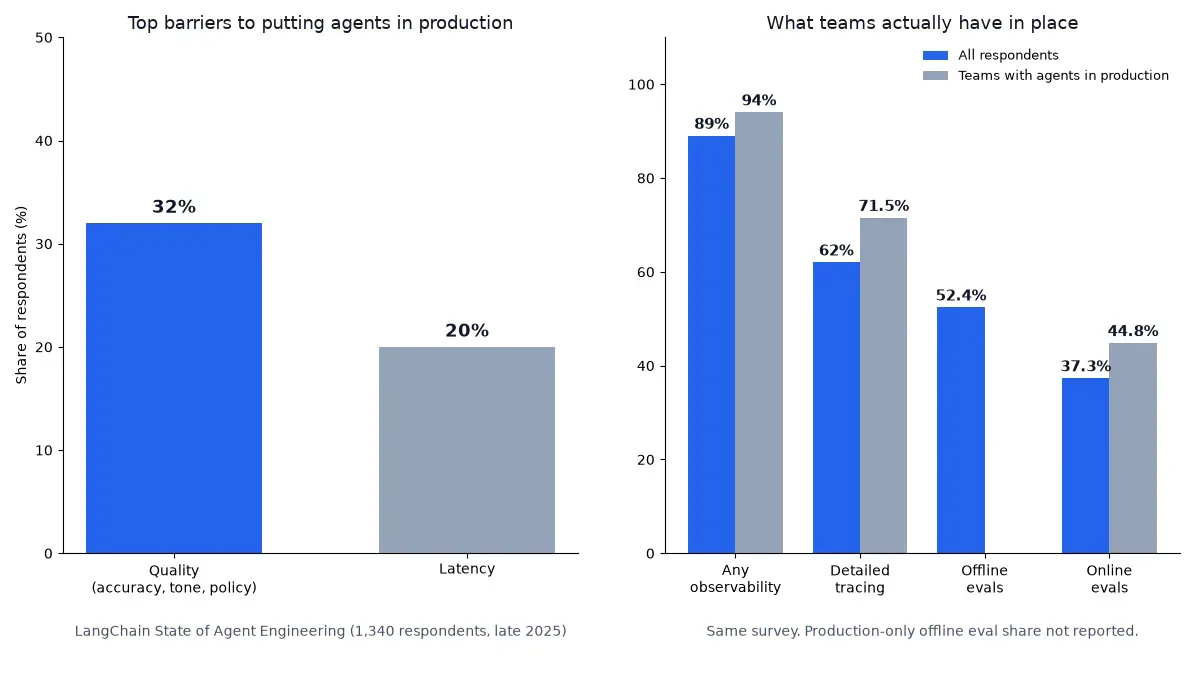
- Quality is the top barrier, cited by 32%. That covers accuracy, consistency, and whether the agent sticks to the right tone and to your policies.
- Latency is second, at 20%, as more agents face customers directly.
- At companies with 2,000+ employees, security is the second biggest concern (24.9%).
None of those are model problems you can solve by waiting for the next release. They are engineering and process problems. Which is good news, because those you can fix.
Your company is responsible for what the agent says
If you only remember one thing from this post, make it this.
In February 2024, a Canadian tribunal ruled in Moffatt v. Air Canada. The airline's website chatbot told a grieving customer he could claim a bereavement discount after booking. That was wrong. Air Canada argued it should not be held liable for what its chatbot said. The tribunal called that "a remarkable submission", said it should be obvious the company is responsible for all the information on its website, and ordered Air Canada to pay $812.02 in damages, interest, and fees.
The amount was small. The principle is not. Whether your buyers are in the US, UK, or UAE, assume a customer, a regulator, or a court will treat your agent's words and actions as your company's words and actions. Design for that from day one.
The guardrails checklist
These are in the order I would put them in place. None of them is exotic. Most teams skip them because the demo did not need them.
1. Give it a narrow job and a clear "no"
Write down, in one paragraph, what the agent does and what it must never do. "Answers questions about our plans and opening hours, books demos, and hands anything about billing, refunds, legal, or medical topics to a person."
Then enforce the "never" list in code, not just in the prompt. A prompt is a request. A rule in your backend is a guarantee.
2. Least privilege for every tool
The OWASP Top 10 for LLM applications (2025) lists Prompt Injection as the number one risk and Excessive Agency as number six. In plain terms: someone will try to talk your agent into doing things, and the damage is limited by what the agent is allowed to do.
- Give it read-only access wherever read-only is enough.
- Scope API keys to the exact actions it needs, not an admin token "for now".
- Never let it see data from one customer while it is serving another.
- Treat anything it reads from emails, web pages, or uploaded files as untrusted input.
3. A human approves anything irreversible
Refunds, discounts, deleting records, sending money, emailing a whole list, changing a contract. The agent can prepare these. A person clicks approve. Once you have a few months of logs showing it gets them right, you can raise the threshold, for example auto-approving refunds under $20.
4. Hard limits on spend, steps, and time
OWASP calls this Unbounded Consumption. Agents call models in loops, and a loop with no ceiling is a bill with no ceiling.
- Cap the number of steps or tool calls per task.
- Set a daily and monthly spend limit with your model provider, plus an alert at 50% and 80%.
- Time out any task that runs longer than it reasonably should.
- Rate limit per user, so one person (or one bot) cannot run up your costs.
5. Log every step, not just the final answer
When something goes wrong, "the AI said something weird" is not a bug report. You need the full trace: the input, which tools it called, what came back, and what it decided. The LangChain survey found 89% of teams have some observability for their agents, and 94% of teams with agents in production do. 71.5% of production teams have full step-by-step tracing. If you are shipping without it, you are in a small and unlucky minority.
6. Test it like you would test a new hire
Before launch, build a test set of 50 to 200 real questions and tasks, including the awkward ones: angry customers, off-topic requests, attempts to get a discount, questions in a second language, someone pasting in "ignore your instructions". Run the agent against that set every time you change the prompt, the model, or the tools.
This is the step most teams skip. In the same survey, only 52.4% run offline evaluations on test sets, and only 37.3% evaluate live production traffic. That is a big gap next to the 89% who have logging. Logs tell you what went wrong after a customer saw it. Tests catch it before.
7. A clean handoff to a person
When the agent is unsure, it should say so and pass the conversation to a human with the full context, so the customer does not have to repeat themselves. Decide in advance what "unsure" means: low confidence, a topic on the "never" list, a customer asking for a person, or a second failed attempt.
8. A kill switch you have actually tested
You should be able to turn the agent off, or drop it back to "collect details and a person will reply", in under a minute, without a deploy. Test that switch before launch. You do not want to discover it does not work on the day you need it.
What it costs to get this right
Founders often expect guardrails to double the budget. In my experience they add something like a few extra days to a few weeks, depending on how many systems the agent touches. That is much cheaper than one bad week in production.
The ongoing cost is mostly attention: someone reviewing a sample of conversations each week, adding new cases to the test set, and watching spend and error alerts. It is a small job, but it has to be somebody's job.
An AI agent is not a feature you launch and forget. It is closer to a new team member with very fast hands and no common sense. You would not give a new hire admin access and no manager on day one. Do not do it to your agent either.
When you should not build an agent at all
Sometimes the right guardrail is not building one. If the task follows the same steps every time, a normal automation or a simple form is cheaper, faster, and far more predictable. Gartner makes the same point: many use cases being sold as agentic today do not need agentic implementations.
A rough rule I use: if you can draw the whole process as a flowchart with no "it depends" boxes, automate it. If it needs judgement on messy, unstructured input, an agent may earn its keep, with the guardrails above.
How we help
At Fionetix we build custom AI agents wired into real CRMs and internal APIs, and the guardrails above are part of the build, not an upsell.
- Not sure an agent is the right tool? Our AI Consultancy & Learning package ($999) includes an AI opportunity audit and roadmap, implementation guidance, and training for your team, so you know what to build and what to skip.
- If the job is really a repeatable workflow, our Legacy Automation package ($1,499) automates it inside the systems you already use, with documentation and handover.
- Need the agent built? Our Custom Software package ($1,999, about a month) delivers a production-ready application with clean architecture.
- Already have an agent live? Our Software Maintenance retainer ($1,899 a month, or $499 a week) covers monitoring, fixes, and updates, and hourly consultancy starts at $30 if you just want a second opinion on what you have.
You own 100% of the code and IP from day one.
Run the checklist this week
Take the agent you have, or the one you are planning, and go through the eight points above. Most teams find two or three gaps in an afternoon. Close those before launch and you are already ahead of a large share of the projects Gartner expects to be canceled.