

The question behind almost every quote
When a founder asks us for a quote, the real question is usually not "how much?" It is "how sure can I be about how much?"
That is what the contract model decides. Fixed price, time and materials, and retainers are not just billing formats. They decide who carries the risk when things change, and in software, things always change.
I have seen founders lose money on all three. Not because one model is bad, but because they picked the wrong one for the stage they were in. So here is the plain version of how each one works and when it fits.
Why software budgets slip in the first place
Before comparing models, it helps to know what you are protecting against.
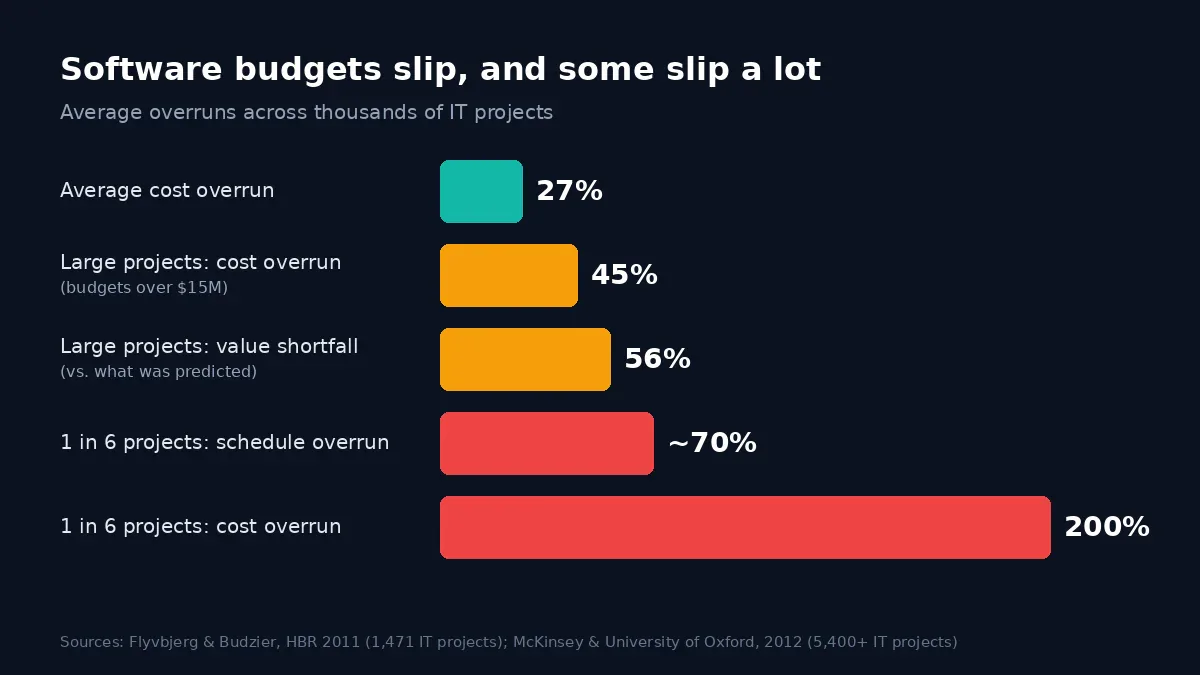
Research from the University of Oxford looked at 1,471 IT projects and found the average cost overrun was 27%. That sounds manageable until you see the tail. One in six projects was a "black swan," with an average cost overrun of 200% and a schedule overrun of almost 70%.
A separate McKinsey and Oxford study of more than 5,400 IT projects found that large projects ran 45% over budget and delivered 56% less value than predicted. It also found that every extra year a project runs adds about 15% to its cost overrun.
Those are mostly big corporate projects, not startup MVPs. But the lesson carries over. Software does not usually fail because people are lazy. It fails because the scope was fuzzy, the estimate was a guess dressed up as a number, and nobody agreed upfront on who pays when reality shows up.
Model 1: Fixed price
You agree on a defined scope, a price, and a deadline. The team delivers that scope for that price.
Where it shines
- You know exactly what you will spend, which makes investors and finance people happy
- It forces both sides to write the scope down clearly before any code is written
- It works well for well-understood work: an MVP with a clear feature list, a website, an integration, an automation of an existing process
Where it hurts
- Every change becomes a change request, and change requests are where many agencies make their margin
- Vendors price in a risk buffer, so you often pay more than the work actually costs
- If the scope was vague, you get arguments about what "done" means instead of a better product
- Some teams quietly cut corners on testing and documentation to protect the fixed number
Model 2: Time and materials
You pay for the hours or days the team actually works, usually against an agreed rate and a rough estimate.
Where it shines
- You can change direction weekly without renegotiating a contract
- You only pay for work that actually happens, with no hidden risk buffer
- It suits discovery, early product iteration, and messy legacy systems where nobody knows what is inside yet
Where it hurts
- Your final bill is open-ended unless you set limits
- It needs more of your attention: reviewing progress, prioritizing, saying no
- With the wrong partner, slow work simply costs more
Time and materials does not have to mean a blank cheque. The best version has a weekly or monthly cap, a visible backlog, and demos you can actually click through. If you cannot see working software every week or two, you are paying for activity, not progress.
Model 3: Retainer or dedicated capacity
You pay a set amount each week or month for a block of a team's time. Think of it as reserving capacity rather than buying a project.
Where it shines
- Predictable monthly spend with the flexibility of time and materials
- Great for products that are already live and need steady improvements, fixes, and support
- The same people stay on your product, so context is not lost between projects
Where it hurts
- If you do not have a clear backlog, you can pay for capacity you do not use
- Long lock-in periods can trap you with a team that is not working out
The detail that matters most here is the exit. A retainer you can pause or cancel is a tool. A 12-month commitment with a team you have not tested yet is a bet.
A quick way to decide
In practice, most healthy products use more than one model over their life:
- Discovery on time and materials, short and capped, to turn an idea into a real scope
- Build on a fixed price, once the scope is clear enough to price honestly
- Run and grow on a flexible retainer, so improvements keep shipping without new contracts every month
Contract clauses worth fighting for
Whatever model you choose, these protect you:
- Clear acceptance criteria. "Done" should be testable, not a feeling.
- A change process with prices. For fixed price work, agree upfront how changes are estimated and approved.
- A cap or a budget alert. For time and materials, the team should warn you before you pass an agreed amount.
- Weekly demos. Working software on a staging link beats status reports.
- Exit terms. Short notice periods, and a documented handover if you leave.
- IP ownership from day one. The code, repos, and accounts should be yours from the first commit, whatever the billing model. We wrote a full IP and access checklist for founders if you want to go deeper.
Questions to ask before you sign
Ask any team you are talking to:
- What exactly is included, and what would count as a change?
- How did you arrive at this estimate, and what are the biggest risks in it?
- How often will I see working software?
- What happens if we need to stop halfway?
- Who owns the code and the accounts while the project is running?
A good team answers these without getting defensive. A great one will raise them before you do.
The right contract is the one that lets your dev team tell you the truth early. If bad news costs them money, you will hear it late.
How we price at Fionetix
We use both approaches on purpose, because founders need different things at different stages.
- Fixed-scope packages for work we can define clearly. Our Custom Software package delivers a production-ready application in about a month for $1,999, with 100% source and IP ownership. Legacy Automation and AI Consultancy have their own fixed packages too.
- Flexible time-based plans for everything that is still moving, from $30 an hour for consultancy up to weekly and monthly plans. No long contracts, and you can pause or cancel anytime.
If you are not sure which fits your project, that is a good first conversation to have. Bring your idea or your current quote, and we will tell you honestly which model makes sense and where the risks are.