
The roadmap is late again
You planned six features for the quarter. Two shipped. The team says they were busy, and you believe them, but you cannot point to where the time went.
So the conclusion feels obvious. The engineers are slow. Maybe you need more of them, or better ones.
Before you hire, look at the data. In most teams I have worked with, the problem is not speed. It is that a huge share of the week never reaches the roadmap in the first place.
What the 2025 data says about engineering time
New Relic's 2025 Observability Forecast surveyed 1,700 IT and engineering leaders and practitioners across 23 countries. A few numbers stand out for founders:
- 33% of engineering time goes to firefighting or addressing disruptions.
- Another 33% goes to maintenance and technical debt. That means more than two thirds of an engineer's week is spent on something other than new features.
- 41% of leaders still learn about service interruptions through customer complaints, incident tickets, or manual checks.
- High-impact outages carry a median cost of $2 million per hour, about $33,333 a minute. Organizations with full-stack observability reported half that, around $1 million per hour.
- 73% of organizations do not have full-stack observability, so large parts of their stack are effectively unmonitored.
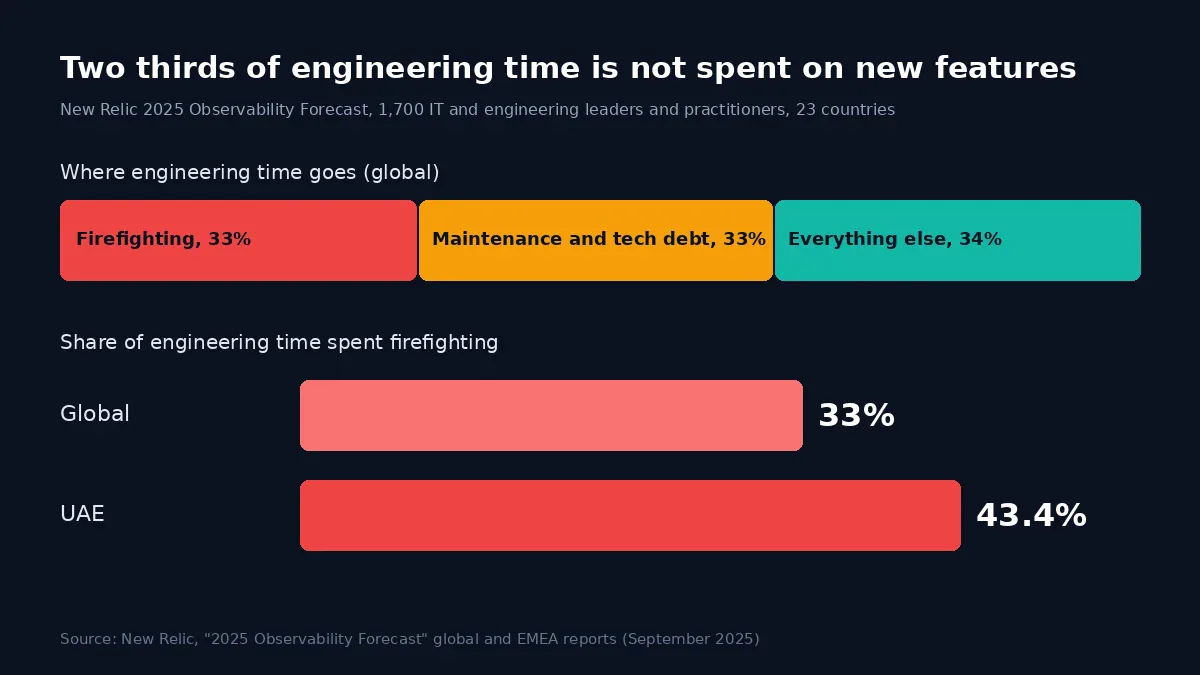
Those outage figures come from large companies, so do not panic about the dollar amount if you are a 20-person startup. The ratio is the part that applies to everyone. If you pay for five engineers, the data suggests you are getting less than two engineers' worth of feature work.
The UAE and UK picture
If you run a team in the Gulf or the UK, the regional breakdown in New Relic's EMEA report is worth a look.
UAE. Engineering teams spend 43.4% of their time addressing disruptions, well above the global figure. 46% of UAE engineering teams spend at least half their time on disruptions. For high-business-impact outages, UAE teams report around 45 minutes to detect and 49 minutes to resolve, among the slowest response times globally. The report puts the median annual cost of those outages at $238.6 million, the highest in EMEA.
UK and Ireland. The median annual cost of high-business-impact outages is $38 million, and 34% of businesses do not track the financial impact of outages at all. That second number is the one that worries me. You cannot fix a cost you never measure.
The worst monitoring system is your customer
Here is my honest take after more than ten years of building and maintaining production systems, including banking software where downtime is not an option.
The worst monitoring system is your customer. By the time they email you, the problem has already cost you money, trust, and an engineer's whole afternoon.
When a customer is your alerting system, every incident follows the same painful path:
The real damage is not the single incident. It is the loop. Without monitoring, the team fixes the symptom, never finds the root cause, and the same fire comes back next month. Meanwhile your roadmap absorbs the hit every single time.
Compare that with a team that has basic observability:
Same engineers. Same skill. Very different week.
Five signs your team is firefighting, not slow
You do not need a survey to know if this is happening. Look for these patterns:
- Estimates are fine, but delivery is not. Engineers estimate a feature at three days and it takes eight. Ask where the other five went. It is usually interruptions.
- The same bugs keep coming back. Recurring incidents mean nobody had the time or the data to fix the root cause.
- You hear about outages from customers or sales. If your first alert is a support ticket, you are in that 41%.
- One person is "the only one who knows" a system. Every incident in that area waits for them, and everything else they own stalls.
- Nobody wants to deploy on Friday. Fear of releasing is a sign there are no safety nets: no tests on key flows, no quick rollback, no visibility after a release.
If three or more of these sound familiar, you have a capacity problem disguised as a performance problem.
How to measure the fire before you fight it
Give it two weeks. You do not need new tools to start.
- Tag unplanned work. Every ticket, Slack request, or hotfix that was not in the sprint gets a simple "unplanned" label.
- Track hours, roughly. Ask the team to note how much of each day went to unplanned work. Rough numbers are fine.
- Log every incident. When it started, how you found out, when it was fixed, and what caused it.
- Count who found it first. Was it a monitor, an engineer, or a customer?
At the end of two weeks you will have your own version of the New Relic numbers. In my experience, founders are usually surprised, and the team is usually relieved that someone finally noticed.
A practical way out of firefighting
You cannot stop every fire, but you can make most of them smaller, rarer, and faster to put out. This is the order that tends to work.
1. See it before customers do
Start with the basics: uptime checks on your key pages and APIs, error tracking in the app, and server metrics for CPU, memory, and disk. Alerts should reach a real person, not a shared inbox nobody reads.
2. Make the noise useful
More alerts are not better. Too many alerts trains people to ignore them. Keep the ones tied to customer impact, such as failed checkouts, login errors, and slow pages, and tune or remove the rest.
3. Fix root causes, not symptoms
Each incident gets a short written note: what happened, why, and what change stops it from happening again. Then actually schedule that change. This is how recurring fires stop recurring.
4. Pay down the debt that causes fires
Not all technical debt matters. The debt worth fixing first is the kind that keeps setting things on fire: an old server nobody patches, a dependency years out of date, a fragile integration with no tests. If your system is old enough that this list feels long, our guide on whether to rewrite or refactor legacy software walks through how to decide.
5. Protect feature time on purpose
Rotate one person as the on-call responder each week so the rest of the team can stay focused. Firefighting does not disappear, but it stops interrupting everyone at once.
What changes when the fires go down
When teams get firefighting under control, the change shows up fast:
- Roadmaps become believable. Estimates hold because the week is not hijacked.
- Customers stop being your QA team. Problems get caught and fixed before most users notice.
- Hiring decisions get honest. You can see whether you truly need more engineers or just fewer interruptions.
- Your best people stay. Constant firefighting is one of the fastest ways to burn out a strong engineer.
None of this is glamorous. It is monitoring, alerts, notes, and steady fixes. That is exactly why it works.
How we help teams get out of firefighting mode
At Fionetix, this is one of the most common situations founders in the US, UK, and UAE bring to us. The product works, customers pay, and the team spends most of its week reacting instead of building.
Our Legacy Fix & Server package is built for that:
- Diagnose and fix the legacy issues that keep coming back
- Performance and security hardening
- Server setup and ongoing management
- A stabilized, documented handover so your team is not guessing next time
It is a fixed $1,999 package, and you keep 100% of the code and IP from day one. If you want ongoing cover after that, our maintenance plans include uptime and performance monitoring. And if you just want a second opinion first, hourly consultancy starts at $30.
Stop asking why the team is slow
Ask where the week went instead. Measure the unplanned work, put monitoring in front of your customers, and fix the fires that keep coming back.
Most of the time you will find you already have a good team. They just need the room to build.